What Is AI-Powered Go-To-Market Automation and How Does ClaudeGTM & Clay MBA Work?
AI is changing how businesses approach sales, marketing, lead generation, and customer acquisition. Instead of relying entirely on manual prospect research, repetitive data entry, and disconnected sales tools, modern businesses can connect artificial intelligence with structured data and automated workflows. This approach is often described as AI-powered go-to-market automation.
AI-powered go-to-market automation uses AI systems, data-enrichment platforms, automation tools, and sales processes to make different parts of a company’s go-to-market operation more connected and efficient. These systems can assist with activities such as finding prospects, researching companies, enriching lead information, preparing personalized messaging, organizing sales data, and supporting outbound workflows.
One program focused specifically on this area is ClaudeGTM & Clay MBA by Hans Dekker. The program combines Claude-based AI sales agents with Clay training, data enrichment, prospect research, workflow automation, and modern GTM processes. CourseCanvass describes it as an AI and automation program for founders, GTM professionals, sales teams, agencies, marketers, and revenue operators.
What Is AI-Powered Go-To-Market Automation?
Go-to-market, commonly shortened to GTM, refers to the systems and processes a business uses to bring its products or services to customers. It can include marketing, sales, prospecting, customer research, outreach, revenue operations, and related activities.
Traditional GTM processes often involve several separate tools. A sales professional might use one platform to find companies, another to research prospects, another to enrich contact information, another to write outreach, and another to manage campaigns.
AI-powered GTM automation attempts to connect these activities.
For example, a workflow could begin by identifying companies that match an ideal customer profile. Data can then be enriched with additional company or contact information. AI can analyze the available information and prepare research or personalization ideas. A human can then review the information before deciding how to proceed.
The important idea is not simply “automate everything.” Instead, AI can handle repetitive research and processing while people remain involved in strategy, communication, relationship building, and important decisions.
Hans Dekker’s own AI-for-GTM guide similarly emphasizes using AI for research, data analysis, personalization, and workflow automation while keeping humans involved in areas requiring judgment and relationships.
Who Is Hans Dekker?
Hans Dekker is an AI-powered GTM strategist and the creator associated with Clay MBA and ClaudeGTM. His background includes founding Lyne.ai, and his public materials state that he has worked with more than 200 B2B teams. His current work focuses on applying AI and data systems to sales and go-to-market operations.
Dekker’s approach focuses on using AI as an assistant for sales and GTM professionals rather than assuming that every part of selling should become autonomous.
His published GTM material describes workflows in which Clay can provide company and prospect information, Claude can perform deeper research and analysis, and human users can review the resulting information before it is used in outreach.
This practical perspective is relevant to ClaudeGTM & Clay MBA because the program combines the AI-agent side of GTM with the data and enrichment side.
What Is ClaudeGTM?
ClaudeGTM is the AI-agent component of the program.
According to the course information, ClaudeGTM teaches users to build specialized AI sales agents inside Claude’s Project environment. These agents can share information such as a GTM playbook, ideal customer profile information, and case studies rather than operating as completely isolated prompts.
This shared-context approach is important because sales and marketing workflows usually require several types of research.
One AI workflow might focus on account research, while another could help with prospect analysis or outreach preparation. Connecting these capabilities can create a more organized process than repeatedly starting from a blank prompt.
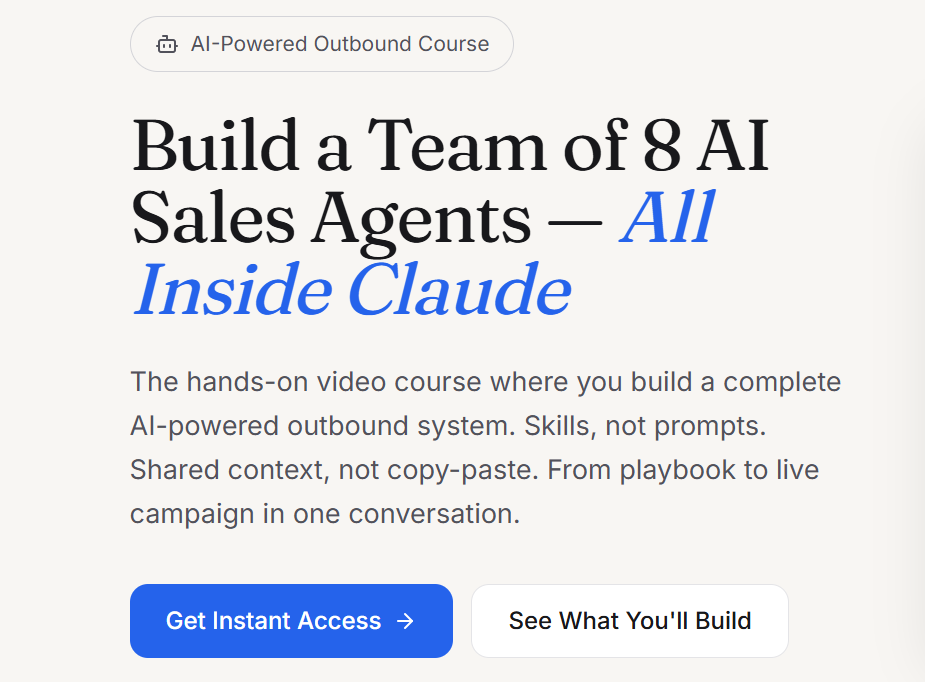
The course information describes ClaudeGTM as including 18 hands-on walkthroughs and training around eight specialized AI sales agents, orchestration, and integrations.
What Is Clay MBA?
The Clay MBA component focuses on Clay, a platform widely used for data enrichment and GTM workflows.
Data enrichment involves taking basic information about a company or prospect and adding useful information to create a more complete profile. For example, a GTM workflow may combine company details, industry information, roles, business signals, and other available data.
According to the course listing, Clay MBA provides structured training across 10 modules and includes hands-on assignments and a completion certificate.
This makes Clay the data-oriented side of the overall system, while ClaudeGTM provides the AI-agent and orchestration layer.
Together, the two components are designed around a simple concept:
Data + AI agents + automation + human oversight = a more connected GTM workflow.
How Does ClaudeGTM & Clay MBA Work?
The program can be understood as two connected layers.
1. Prospect and Company Data
The first layer involves collecting and organizing useful prospect information.
Clay can be used for data enrichment and prospect research. Better data gives AI systems more context to work with.
2. AI Research
Once useful information is available, AI can help analyze it.
For example, an AI workflow can examine company information, identify relevant business signals, summarize research, and prepare information for a sales professional.
3. Shared AI Context
ClaudeGTM introduces shared context between specialized AI sales agents.
Instead of treating every prompt as a completely separate task, agents can work from common information such as an ICP, GTM playbook, and case studies.
4. Workflow Orchestration
The next step is connecting individual capabilities into a broader workflow.
Research, data enrichment, personalization, and campaign preparation can be connected so that information moves from one stage to another rather than being manually copied between multiple systems.
5. Integrations
The course information also discusses MCP connectors and integrations involving tools such as Clay, Instantly, and Exa. These connections can allow different components of a GTM workflow to communicate with one another.
6. Human Review
Human review remains important.
AI-generated research or messaging should not automatically be treated as correct. People can review information, check context, make strategic decisions, and determine what should actually be used in a customer-facing workflow.
This human-plus-AI approach is also emphasized in Hans Dekker’s public GTM material.
What Can You Learn From ClaudeGTM & Clay MBA?
The program brings together several areas of modern GTM automation, including:
- Claude AI sales agents
- AI agent orchestration
- Clay data enrichment
- Prospect research
- GTM workflows
- Outbound automation
- MCP connectors
- AI-assisted personalization
- Sales automation
- Data workflows
- GTM engineering
- Shared AI context
- Repeatable sales systems
The CourseCanvass listing specifically identifies Claude AI agents, Clay, data enrichment, prospect research, MCP connectors, outbound automation, and GTM engineering among the program’s major areas.
Why Is AI-Powered GTM Automation Useful?
One of the biggest challenges in modern sales operations is the amount of repetitive work involved before a meaningful sales conversation even happens.
Teams may need to research companies, identify relevant contacts, collect information, enrich records, analyze business signals, prepare messaging, and organize follow-ups.
AI and automation can assist with many of these repetitive activities.
For example, instead of manually researching every company from scratch, a connected workflow can gather relevant information and produce a structured research brief. A sales professional can then review that information and focus on strategy and communication.
This can also create more repeatable processes. Rather than having every salesperson develop completely different research methods, an organization can document a workflow and improve it over time.
However, automation does not automatically guarantee better sales results. Data quality, workflow design, human review, messaging quality, and the underlying sales strategy still matter.
Who May Benefit From ClaudeGTM & Clay MBA?
ClaudeGTM & Clay MBA may be particularly relevant to people working in areas such as:
Founders: Entrepreneurs can explore ways to organize prospect research and outbound activities without manually performing every repetitive task.
GTM Professionals: People responsible for go-to-market operations can study ways to connect data, AI, and workflow automation.
Sales Teams: Sales professionals can use AI-assisted research and enrichment to prepare for prospecting and outreach.
Agencies: Agencies working with multiple clients may find structured GTM workflows useful for organizing repetitive research and campaign processes.
Marketers: Marketing professionals can explore how enriched data and AI research can support targeted campaigns.
Revenue Operations Professionals: RevOps teams can examine how data pipelines, integrations, and automation can connect different parts of the revenue process.
The course itself identifies founders, GTM professionals, sales teams, agencies, marketers, and revenue operators as relevant audiences.
Why Is ClaudeGTM & Clay MBA Useful?
The main value of the program is its combination of two areas that are often taught separately.
ClaudeGTM focuses on the AI-agent and orchestration layer, while Clay MBA focuses on the data-enrichment and workflow layer.
That combination creates a more complete picture of how AI can be incorporated into a modern GTM operation.
Instead of learning only how to write AI prompts or only how to enrich a database, learners can explore how data, AI agents, integrations, and sales workflows can work together.
The approach can also be useful for understanding the emerging role of GTM engineering, where technical tools, data systems, automation, and sales strategy overlap.
Hans Dekker – ClaudeGTM & Clay MBA
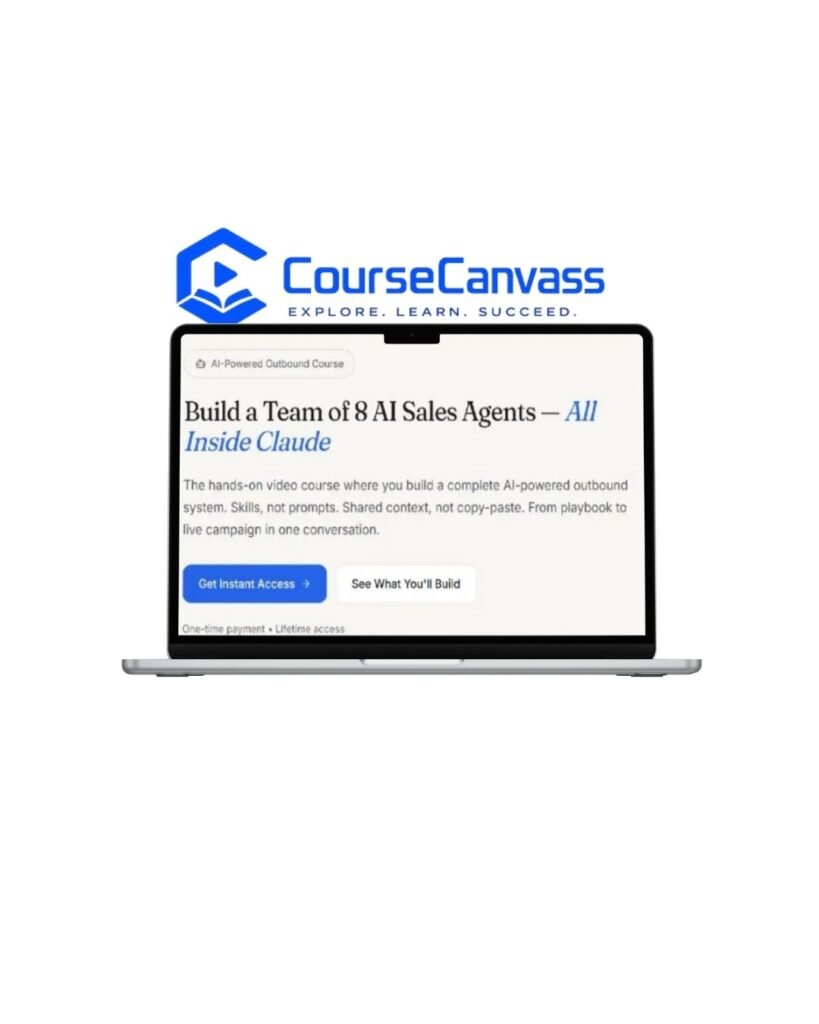
ClaudeGTM & Clay MBA by Hans Dekker (2026) is a premium AI & Automation course designed for founders, GTM professionals, sales teams, agencies, marketers, and revenue operators who want to combine Claude AI agents, Clay data enrichment, prospect research, automation, and modern go-to-market workflows.
The Future of AI-Powered GTM Automation
Go-to-market systems are becoming increasingly connected.
AI agents can assist with research, data can be enriched automatically, and different platforms can communicate through integrations. This creates opportunities for businesses to build more sophisticated workflows than traditional manual prospecting.
At the same time, AI does not remove the need for human judgment.
Hans Dekker’s own GTM guide argues that AI is particularly useful for research, data analysis, workflow automation, and personalization, while relationship building, complex buying processes, objection handling, and closing still require significant human involvement.
This suggests that the future of GTM automation is not necessarily about replacing every human activity. Instead, businesses can use AI to handle repetitive information-heavy work while people concentrate on strategy, relationships, communication, and decision-making.
Conclusion
AI-powered go-to-market automation brings together artificial intelligence, data enrichment, prospect research, workflow automation, and sales processes.
Hans Dekker’s ClaudeGTM & Clay MBA approaches this concept through two connected components: ClaudeGTM for AI sales agents and orchestration, and Clay MBA for data enrichment and GTM workflows. The course information describes training around AI sales agents, shared context, Clay, prospect research, MCP connectors, outbound workflows, and GTM engineering.
For businesses exploring modern sales automation, understanding how these components fit together can provide a useful foundation for thinking about AI-assisted GTM systems. The most practical approach is to use automation for repetitive tasks while keeping humans involved wherever context, judgment, relationships, and strategic decisions matter.
FAQs
What is AI-powered go-to-market automation?
AI-powered go-to-market automation uses artificial intelligence, data, integrations, and automated workflows to support activities such as prospect research, data enrichment, personalization, sales operations, and outbound processes.
What is ClaudeGTM & Clay MBA?
ClaudeGTM & Clay MBA is a program by Hans Dekker combining Claude-based AI sales-agent training with structured Clay training, data enrichment, prospect research, and GTM automation workflows.
Who is Hans Dekker?
Hans Dekker is an AI-powered GTM strategist and creator associated with Clay MBA and ClaudeGTM. His public materials state that he previously founded Lyne.ai and has worked with more than 200 B2B teams.
What does ClaudeGTM teach?
ClaudeGTM focuses on building specialized AI sales agents inside Claude, shared context, AI-agent orchestration, GTM playbooks, and related workflow integrations.
What does Clay MBA teach?
Clay MBA focuses on Clay, data enrichment, prospect research, workflows, structured training, assignments, and related GTM applications. Course information describes it as a 10-module program.
Is AI-powered GTM automation completely autonomous?
Not necessarily. AI can assist with research, analysis, personalization, and repetitive workflow tasks, but human oversight remains important for strategy, relationship building, complex decisions, and reviewing AI-generated information.
What is GTM engineering?
GTM engineering involves using technical tools, data systems, integrations, automation, and AI to build and improve go-to-market processes.
Can Claude and Clay work together?
The ClaudeGTM & Clay MBA program is specifically designed around combining Claude-based AI agents with Clay’s data and enrichment capabilities. The course information also references integrations and MCP connectors involving tools such as Clay, Instantly, and Exa.