
George Ten’s Hobby Arbitrage Method Review
Creating a digital product can be exciting, but one of the biggest challenges is knowing whether people will actually buy it. An entrepreneur can spend weeks developing a course, writing content, building a sales page, and preparing marketing campaigns, only to discover that the market does not respond as expected.
George Ten’s Hobby Arbitrage Method takes a different approach. Instead of beginning with the product itself, the method focuses on identifying existing hobby markets, finding signs of buyer demand, developing an offer around that market, and testing the idea before committing significant resources to production.
The program is designed around the idea that established hobby communities can contain opportunities for digital products and educational offers. Its approach combines market research, positioning, sales-page development, advertising validation, and decision-making.
This makes the course particularly interesting for entrepreneurs and digital-product creators who want to test an opportunity before investing heavily in building it.
What Is George Ten’s Hobby Arbitrage Method?
The Hobby Arbitrage Method is a training program centered on finding potential digital-product opportunities inside established hobby markets.
The core idea is relatively straightforward: rather than trying to invent a completely new market, look for audiences that already have strong interests and already spend money related to those interests.
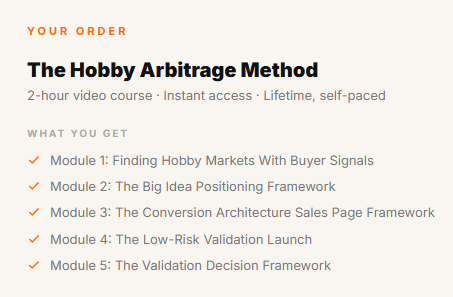
The method then moves through several stages, including identifying potential markets, developing a strong product concept, positioning the offer, creating a sales page, testing the offer, and evaluating the results.
George Ten presents this as a way to reduce the amount of guesswork involved in deciding what digital product to create.
Who Is George Ten?
George Ten is an entrepreneur and marketer associated with digital-product, advertising, and offer-validation training.
His public material places significant emphasis on testing offers and using advertising data to determine whether an idea has commercial potential.
One of his more recent public workshops focuses specifically on using a small Meta advertising test to determine whether an offer can attract buyers. The workshop describes a roughly $50 test designed to provide an early market signal rather than relying entirely on opinions or assumptions.
What Does the Hobby Arbitrage Method Teach?
The program can be understood through several main areas.
1. Finding Hobby Markets
The first step is identifying hobby markets that already demonstrate signs of interest and purchasing behavior.
Examples of hobby markets can include activities such as crafts, creative skills, collecting, fitness-related hobbies, and other enthusiast communities.
The important distinction is that the method is not simply about finding a hobby with many people interested in it. The objective is to identify markets where there may already be demand for education, information, products, or solutions.
This can give an entrepreneur a starting point for evaluating whether a market deserves further research.
2. Looking for Buyer Signals
Audience size alone does not prove that a market is commercially attractive.
The method focuses on finding buyer signals—evidence that people are willing to spend money within a particular market.
This can include existing products, courses, workshops, communities, tools, or other paid solutions.
Understanding these signals can help entrepreneurs distinguish between an audience that is merely interested in a subject and an audience that actively spends money related to it.
3. Developing the Big Idea
After identifying a market, the next challenge is determining what the actual product should be.
A digital product needs a clear reason for customers to choose it.
The Hobby Arbitrage Method therefore places importance on developing the central idea and positioning of the offer.
Instead of simply creating something broad such as a “complete guide,” the entrepreneur needs to think about the specific audience, problem, desired outcome, and reason the product deserves attention.
4. Creating a Strong Offer
A good market does not automatically produce a successful product.
The offer still needs to communicate why the product is useful and who it is designed for.
This is where positioning becomes important.
The entrepreneur needs to understand what the target audience wants and then communicate the product in a way that connects the offer with that demand.
5. Building the Sales Page
The program also focuses on sales-page structure.
A sales page is where the entrepreneur communicates the problem, opportunity, offer, value, and next step to a potential customer.
A well-structured page can make it easier to test an idea because the entrepreneur has a concrete offer that can be presented to the market.
6. Testing Before Building Everything
One of the most interesting aspects of the approach is validation before full production.
Instead of spending a large amount of time creating an entire course first, the entrepreneur can test the offer with a smaller advertising campaign.
George Ten’s public validation material describes a Meta advertising test using approximately $50 in ad spend to generate an early signal about whether an idea can sell.
The objective is not to guarantee success. It is to gather evidence before making a larger investment.
Why Is the Hobby Arbitrage Method Useful?
The main appeal of this approach is its emphasis on testing before building.
Traditional digital-product creation can involve a lot of upfront work:
- Researching the subject
- Recording lessons
- Creating documents
- Building a website
- Designing a sales page
- Setting up payments
- Creating marketing material
If the underlying offer is weak, much of that work may not produce the desired result.
The Hobby Arbitrage Method attempts to reverse the order.
Instead of:
Build → Launch → Discover what happens
the approach is closer to:
Research → Position → Test → Evaluate → Build
This can make the product-development process more evidence-driven.

George Ten – The Hobby Arbitrage Method 2026
George Ten – The Hobby Arbitrage Method 2026 explores hobby-market arbitrage, product research, sourcing, pricing, supply and demand, and online resale strategies. Designed for collectors, hobby enthusiasts, beginner resellers, and entrepreneurs, the program provides a structured approach to identifying and evaluating potential opportunities in niche hobby markets.
What Are the Benefits?
Potential benefits of studying this approach include:
- Learning how to research hobby markets
- Identifying potential buyer signals
- Developing digital-product ideas
- Improving offer positioning
- Understanding sales-page structure
- Learning basic market-validation concepts
- Testing an offer before full production
- Using advertising data for decision-making
- Reducing unnecessary upfront work
- Understanding how digital products can be built around existing demand
The method can therefore be useful for entrepreneurs who want to make product-development decisions based on market evidence rather than assumptions.
Who Is the Hobby Arbitrage Method For?
The course may be relevant to:
- Entrepreneurs
- Digital-product creators
- Course creators
- Online-business owners
- Marketers
- Copywriters
- Creators
- Information-product entrepreneurs
- People researching new business ideas
- People interested in niche markets
It can be especially interesting for someone who is comfortable with marketing and business development but does not necessarily want to personally become an expert in every subject they sell.
Does It Require You to Be an Expert?
One interesting aspect of the model is that the business owner does not necessarily have to personally possess all of the subject expertise.
If an opportunity is validated, the entrepreneur can potentially work with a qualified subject-matter expert to develop the educational material.
This creates a distinction between finding and building the business opportunity and delivering the specialist knowledge.
However, any product should still be based on genuine expertise and provide useful, accurate information to customers.
How Does Market Validation Work?
Market validation is essentially about collecting evidence before making a larger commitment.
In George Ten’s public material, the validation process uses a structured advertising test to determine how real people respond to an offer.
The resulting data can help answer questions such as:
- Are people clicking the offer?
- Are they showing buying interest?
- Is the positioning attracting attention?
- Is the sales page converting?
- Is the idea worth developing further?
The important point is that advertising data should be interpreted carefully. A test can provide useful evidence, but it cannot guarantee long-term business success.
What Makes This Approach Different?
The biggest difference is its emphasis on opportunity validation.
Many digital-product discussions begin with content creation. The Hobby Arbitrage Method begins much earlier—with the question of whether there is a commercially interesting market and whether a proposed offer receives a positive response.
This can help entrepreneurs avoid one common mistake: building a large product before establishing whether the market actually wants it.
Can the Method Be Used for Different Niches?
The underlying concept is not limited to one particular hobby.
The principle can potentially be applied to many markets where people have strong interests and existing purchasing behavior.
However, each niche has its own characteristics.
Competition, audience size, pricing, customer expectations, advertising costs, and existing products can all influence whether an opportunity is attractive.
Therefore, the framework should be treated as a research and testing approach rather than a guarantee that every hobby market will produce a successful business.
What Skills Can You Develop?
Studying and applying the concepts can help develop skills in:
Market Research: Understanding audiences and identifying potential opportunities.
Niche Research: Examining specific markets rather than targeting everyone.
Offer Positioning: Communicating why a product is relevant to a particular audience.
Sales Pages: Structuring information to communicate an offer clearly.
Market Validation: Testing demand before investing heavily in development.
Advertising Testing: Using controlled campaigns to gather market signals.
Data Analysis: Interpreting early results and deciding what to do next.
Product Strategy: Deciding whether to build, change, or abandon an idea.
What Are the Limitations?
The Hobby Arbitrage Method should not be viewed as a guaranteed business model.
A market may show initial interest without producing a profitable long-term business.
Advertising performance can also be affected by many variables, including:
- Ad creative
- Targeting
- Offer positioning
- Price
- Sales-page quality
- Market competition
- Product quality
- Customer experience
- Advertising costs
A positive early test is therefore only one piece of evidence.
Entrepreneurs still need to build a valuable product, deliver it properly, support customers, and develop a sustainable acquisition strategy.
George Ten’s public validation material also presents its examples as demonstrations of the method rather than guarantees that every learner will achieve similar results.
Is the Hobby Arbitrage Method Good for Beginners?
The framework can be approachable for beginners because it focuses on a relatively clear sequence:
Find → Position → Test → Evaluate → Build.
However, applying the approach successfully still requires learning practical skills such as market research, copywriting, offer creation, advertising, and data interpretation.
Beginners should therefore think of the course as a framework for experimentation rather than a shortcut that removes the need to learn business fundamentals.
What Does the Course Focus On Most?
At its core, the Hobby Arbitrage Method focuses on one major question:
Is there enough evidence that people want this offer before you invest heavily in building it?
That question connects the different parts of the approach—from finding buyer signals and positioning an idea to creating a sales page and testing the offer.
This makes market validation the central theme of the method.
Is It Worth Exploring?
Whether the Hobby Arbitrage Method is worthwhile depends on what the learner wants.
Someone looking for an advanced advertising course may want a broader program. Someone looking for detailed instruction on producing a specific type of hobby content may also need additional training.
However, entrepreneurs interested in digital products, niche research, market validation, and testing offers before investing heavily in production may find the framework particularly relevant.
Its greatest value is arguably the emphasis on gathering evidence before committing significant time and resources.
Where Can You Learn More?
George Ten’s public website provides information about his training and validation methodology, while CourseCanvass currently lists George Ten – The Hobby Arbitrage Method 2026 among its new courses. CourseCanvass currently displays the course at $28, with a higher crossed-out price shown on the listing.
For CourseCanvass, the course fits naturally within the Business Strategy category because its central themes include opportunity research, market validation, product positioning, and digital-business strategy.
Final Verdict
George Ten’s Hobby Arbitrage Method is an interesting course for entrepreneurs who want to validate digital-product opportunities before spending significant time building them.
Its approach is centered around researching established hobby markets, identifying buyer signals, developing an offer, creating a sales page, testing the offer, and using the results to decide what happens next.
The biggest takeaway is simple: don’t assume an idea will sell—test the market first.
That principle can be useful beyond hobby markets. It encourages entrepreneurs to treat product creation as an evidence-driven process rather than relying entirely on intuition.
For someone interested in digital products and market validation, the Hobby Arbitrage Method offers a focused framework worth examining.
FAQs
What is George Ten’s Hobby Arbitrage Method?
It is a training program focused on finding opportunities in established hobby markets, developing digital-product offers, and validating demand before investing heavily in production.
Who is George Ten’s Hobby Arbitrage Method for?
It is primarily relevant to entrepreneurs, marketers, digital-product creators, course creators, and online-business owners interested in market validation and niche opportunities.
What does the Hobby Arbitrage Method teach?
It focuses on hobby-market research, buyer signals, offer positioning, sales-page development, advertising validation, and evaluating market-test results.
Does the method involve advertising?
Yes. George Ten’s public validation material describes using a small Meta advertising test to gather an early signal about whether an offer can attract buyers.
Do you need to be an expert in the hobby?
Not necessarily. The model can involve identifying and validating an opportunity and then working with appropriate subject-matter expertise to develop the educational product.
Is the Hobby Arbitrage Method a guarantee of income?
No. Market testing can provide useful evidence, but it cannot guarantee profitability or future business results.
What category is the course?
For CourseCanvass, the recommended category is Business Strategy.
What is the main idea behind the method?
The central idea is to validate demand before investing heavily in building a digital product.