What Is an AI Operator and How Does AI Operator Academy Work?
Artificial intelligence is changing how businesses approach everyday operations, but simply knowing how to use AI tools is not always enough. Businesses also need people who can identify useful AI opportunities, understand existing workflows, design practical systems, and help implement those systems. This is where the idea of an AI operator comes into the picture.
An AI operator is a person who helps businesses apply artificial intelligence and automation to practical business processes. Instead of focusing only on AI technology, an AI operator looks at how a business actually works and identifies where AI can assist with tasks, information management, customer processes, internal workflows, and other operations.
The role can involve understanding a company’s processes, identifying bottlenecks, creating AI-assisted workflows, implementing automation, and helping the business use those systems effectively.
Corey Ganim’s AI Operator Academy is a training and community program built around helping people develop and sell AI services. The current Academy describes a 60-day roadmap, service playbooks, client-acquisition systems, AIOS and Vault resources, live support, and practical guidance for people who want to build AI-service businesses.
Who Is Corey Ganim?
Corey Ganim is an entrepreneur and AI educator who focuses on helping businesses and non-technical professionals understand and apply artificial intelligence in practical ways. His work centers on turning AI from a collection of individual tools into useful business systems and services.
Ganim’s approach emphasizes understanding a business before introducing automation. His website describes this approach through Audit, Optimize, Automate—first examining how a business operates, then improving its processes, and finally identifying opportunities where AI and automation can be applied.
His background also includes building and operating online businesses. According to his official website, Ganim previously built BrandRocket beyond $16 million in e-commerce sales and later shifted his focus toward practical AI applications for business owners and operators.
Through AI Operator Academy, Ganim teaches a business-oriented approach to AI services. The Academy is designed for consultants, agency owners, freelancers, solopreneurs, and other non-technical operators who want to learn how to identify AI opportunities, develop service offers, acquire clients, and deliver practical AI solutions. Its current program description includes a 60-day roadmap, AI assessment and concierge playbooks, knowledge-base resources, client-acquisition systems, AIOS resources, and community support.
Rather than positioning AI solely as a technical subject, Ganim’s training focuses on the connection between business problems, AI solutions, automation, and service delivery. This makes his work particularly relevant to people who want to use AI as part of a business or professional service rather than simply study AI technology.
What Is an AI Operator?
An AI operator is someone who helps businesses use artificial intelligence in practical ways.
Rather than simply recommending an AI tool, an AI operator can look at an organization’s existing workflow and ask questions such as:
- What tasks are repetitive?
- Where is information being handled manually?
- Which processes are slowing the business down?
- Where could AI assist employees?
- Which workflow could be automated?
- What information does the AI system need?
- Where should human review remain?
This makes the role different from simply being an AI tool user.
An AI operator focuses on the application of AI to business operations.
For example, imagine a company receives dozens of customer inquiries every day. An AI operator could help analyze the existing customer-support workflow and determine whether an AI knowledge base, automated classification system, or response-drafting workflow could assist the team.
The operator’s job is not necessarily to replace employees. Instead, the objective can be to make existing processes more efficient and give people better systems to work with.
How Does an AI Operator Work?
An AI operator generally works through a process of understanding, analyzing, designing, implementing, and improving business systems.
1. Understand the Business
The first step is understanding how the business currently operates.
This can include examining customer journeys, internal processes, communication systems, data, documentation, marketing activities, and other workflows.
2. Identify Opportunities
The next step is identifying areas where AI or automation may provide useful support.
Not every process needs AI. A good operator should distinguish between tasks that are suitable for automation and tasks that require human judgment.
3. Design the Workflow
Once an opportunity has been identified, the operator can map out the desired process.
For example:
Customer Request → AI Analysis → Information Retrieval → Draft Response → Human Review → Customer
The workflow will vary depending on the business and its requirements.
4. Implement the System
The operator then helps put the workflow into practice using appropriate AI and automation tools.
This can involve connecting applications, organizing business information, creating prompts or instructions, configuring automations, or establishing repeatable processes.
5. Test and Improve
AI systems need testing.
The operator can examine whether the workflow produces useful results, identify errors, improve instructions, and determine where human oversight should be added.
This ongoing improvement is an important part of operating AI systems in real businesses.
Who Is Corey Ganim?
Corey Ganim is an entrepreneur and AI educator focused on making AI practical for non-technical business operators.
According to his official website, he has started multiple businesses and previously built BrandRocket beyond $16 million in e-commerce sales. His current work focuses on helping non-technical business owners apply AI without needing to become developers.
His approach centers around a framework described on his website as Audit, Optimize, Automate, which focuses on understanding a business, improving its processes, and then applying automation where appropriate.
What Is AI Operator Academy?
AI Operator Academy is Corey Ganim’s community and training program for people who want to build and sell AI services.
The current Academy describes a 60-day roadmap that includes developing a sellable offer, completing a paid assessment, and creating a local client pipeline. It also provides assessment, concierge, and knowledge-base playbooks intended to help members package, price, sell, and fulfill AI services.
The program is aimed at several groups, including consultants, agency owners, solopreneurs, freelancers, and non-technical operators. The Academy specifically presents itself as a way to build AI-service skills without requiring participants to become engineers.
What Does AI Operator Academy Cover?
The current Academy description highlights several areas.
AI Service Offers
One focus is developing an AI service that can be presented as a clear business offer.
Instead of simply telling clients that you “do AI,” an operator needs to understand what problem the service solves and what the client actually receives.
AI Assessments
The Academy includes an assessment playbook designed around evaluating a business and identifying opportunities for AI-related services.
An assessment can help identify repetitive workflows, operational bottlenecks, information gaps, and possible areas for automation.
AI Concierge Services
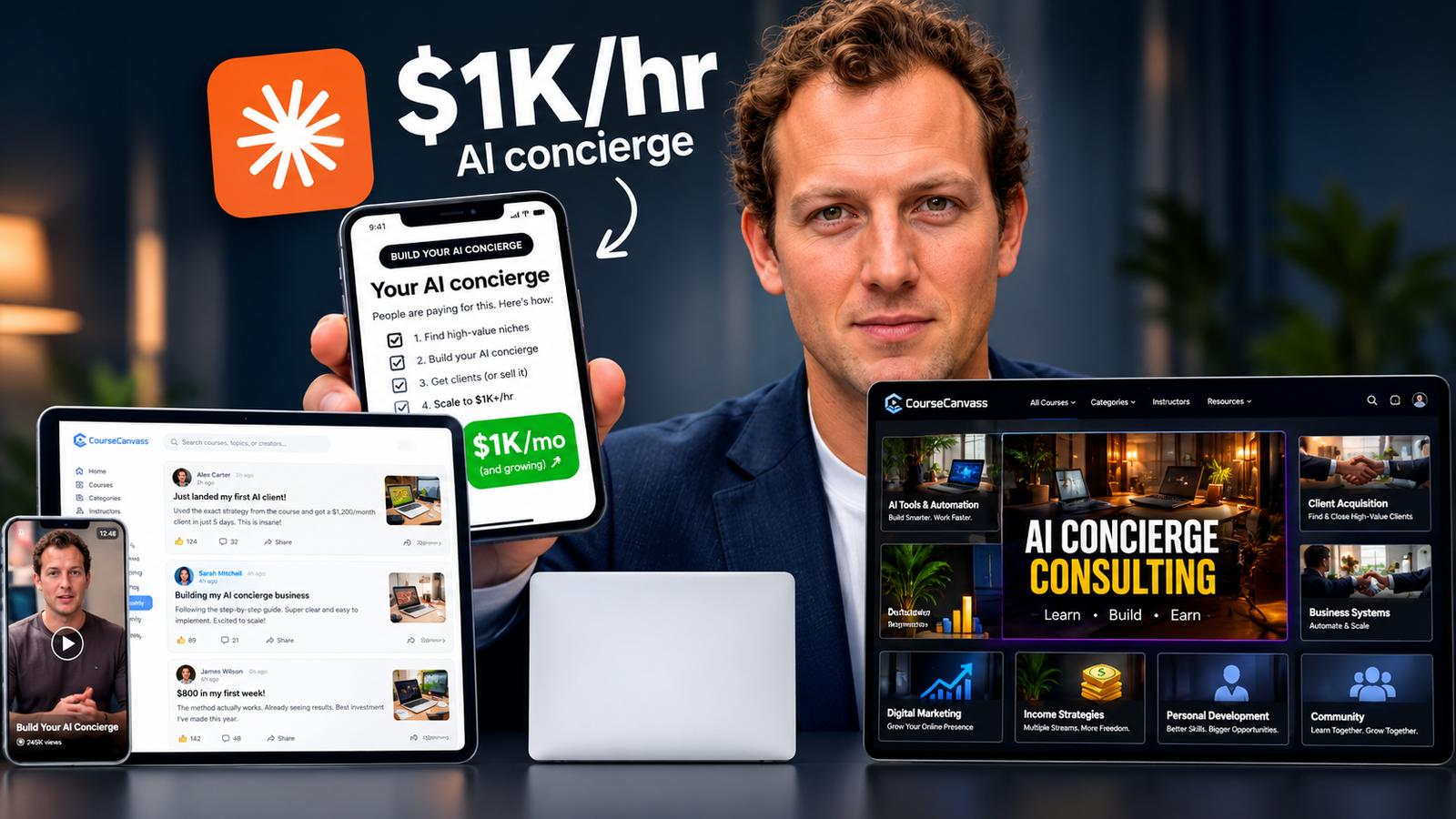
The Academy also includes a concierge playbook. This relates to providing AI-related assistance to businesses and helping clients implement practical solutions.
Knowledge Bases
Business knowledge can be organized into systems that AI can use to assist with tasks such as information retrieval and customer or employee support.
A structured knowledge base can help an AI system work with company-specific information rather than relying only on general knowledge.
Client Acquisition
AI skills are only one part of building an AI-service business. The Academy also includes a client-acquisition system involving methods such as outreach, referrals, partnerships, office hours, and meetups.
AIOS and Other Resources
The Academy’s current description also mentions AIOS, a Vault, replays, and live support intended to help members create deliverables and receive feedback.
Why Is AI Operator Academy Useful?
AI Operator Academy can be useful for people who want to approach AI from a business-service perspective rather than simply learning individual AI tools.
One important distinction is that an AI operator needs to understand both sides of the equation:
Business problem + AI solution
For example, learning how to generate text with an AI model is one skill. Understanding why a company needs an automated knowledge system, designing that system around the company’s information, and helping the company implement it is a broader business application.
The Academy’s current positioning reflects this broader approach by combining service development, client acquisition, fulfillment, playbooks, and community support.

Corey Ganim-AI Operator Academy
AI Operator Academy by Corey Ganim (2026) is a premium AI & Automation course designed for entrepreneurs, consultants, agency owners, freelancers, operators, and business professionals who want to build, package, sell, and deliver AI-powered services using practical no-code automation systems.
What Skills Does an AI Operator Need?
An AI operator can benefit from a combination of technical and business skills.
Business Process Analysis
The operator should understand how businesses work and how different processes connect.
AI Knowledge
Understanding modern AI tools, models, agents, prompting, and AI-assisted workflows can help an operator choose suitable solutions.
Automation
Automation knowledge allows an operator to connect different steps and reduce repetitive manual work.
Communication
An operator needs to explain technical concepts in language that business owners and employees can understand.
Problem Solving
Every business has different workflows, so an operator needs to analyze individual problems rather than applying exactly the same solution everywhere.
Client Service
When AI services are delivered to businesses, understanding client requirements, expectations, feedback, and implementation challenges becomes important.
AI Operator vs. AI Developer
An AI operator and an AI developer are not necessarily the same role.
An AI developer may focus heavily on building software, writing code, integrating APIs, developing applications, or engineering technical systems.
An AI operator can be more focused on applying existing AI capabilities to business processes.
This does not mean an AI operator has no technical knowledge. Rather, the role can emphasize business implementation and practical AI deployment rather than software engineering alone.
AI Operator Academy specifically positions itself toward non-technical operators and says participants do not need to become engineers to deliver its approach to AI services.
Who Can Benefit From Learning About AI Operations?
AI operations can be relevant to several types of professionals.
Consultants can explore AI services as an addition to existing consulting work.
Agency owners can investigate AI-powered services for their clients.
Freelancers can develop AI-related service offerings.
Solopreneurs can learn how AI and automation can support business operations.
Business operators can investigate practical ways to introduce AI into existing workflows.
The Academy itself identifies consultants, agency owners, solopreneurs, freelancers, and non-technical operators as its target audience.
What Makes an AI Operator Different From a Traditional Automation Specialist?
Traditional automation often focuses on predefined rules and workflows.
For example:
If a customer submits a form → add the customer to a database → send an email.
AI can make some workflows more flexible because it can help interpret text, classify information, summarize documents, generate drafts, and work with less-structured inputs.
An AI operator therefore may work at the intersection of:
Business Operations + AI + Automation + Service Delivery
The exact responsibilities depend on the business and the services being provided.
Things to Consider Before Using AI in Business
AI automation can be useful, but businesses should not automate a process simply because automation is possible.
Before implementation, businesses should consider:
- Accuracy
- Data privacy
- Security
- Cost
- Reliability
- Human oversight
- Integration requirements
- Maintenance
- Customer experience
Important business decisions should not automatically be delegated to AI without appropriate review.
A well-designed AI workflow should have clear responsibilities, appropriate safeguards, and a way to identify and correct errors.
Final Thoughts
An AI operator is essentially a bridge between business problems and practical AI solutions.
Rather than focusing only on learning AI tools, the role involves understanding business processes, identifying opportunities, designing workflows, implementing systems, and improving those systems over time.
Corey Ganim’s AI Operator Academy takes this business-oriented approach by combining AI-service development, assessments, service playbooks, client acquisition, fulfillment systems, AIOS resources, and live support. The current Academy is specifically positioned for consultants, agency owners, freelancers, solopreneurs, and non-technical operators who want to build and deliver AI services.
As businesses continue experimenting with artificial intelligence, the ability to connect AI capabilities with real operational needs can become an important skill. AI operators can play a role in helping businesses move from simply experimenting with AI to implementing structured, practical workflows.
FAQs
What is an AI operator?
An AI operator is a professional who helps businesses apply artificial intelligence and automation to practical business processes, workflows, and services.
What does an AI operator do?
An AI operator can analyze business processes, identify AI opportunities, design workflows, implement AI-assisted systems, and help businesses improve those systems.
What is AI Operator Academy?
AI Operator Academy is Corey Ganim’s training and community program focused on helping people build, sell, and deliver AI services. Its current program includes a 60-day roadmap, service playbooks, client acquisition systems, AIOS resources, and live support.
Who is Corey Ganim?
Corey Ganim is an entrepreneur and AI educator who focuses on helping non-technical business owners use AI in practical business operations. His website describes his approach as Audit, Optimize, Automate.
Do you need to be a programmer to become an AI operator?
Not necessarily. AI Operator Academy specifically targets non-technical operators and says its approach does not require participants to become engineers.
What services can an AI operator provide?
Depending on their skills and business model, an AI operator may provide AI assessments, workflow automation, knowledge-base systems, AI concierge services, AI implementation, or other AI-related business services.
What is the difference between an AI operator and an AI developer?
An AI developer generally focuses more on software development and technical implementation, while an AI operator can focus more heavily on applying existing AI and automation capabilities to business processes.
Can AI operators work with small businesses?
Yes. AI operators can work with businesses of different sizes, provided the proposed AI solution addresses a genuine business need and is appropriate for the company’s workflow.
Is AI automation the same as AI operations?
They are related but not identical. AI automation generally refers to automating tasks or workflows using AI, while AI operations can involve the broader process of analyzing, implementing, managing, and improving AI systems within a business.