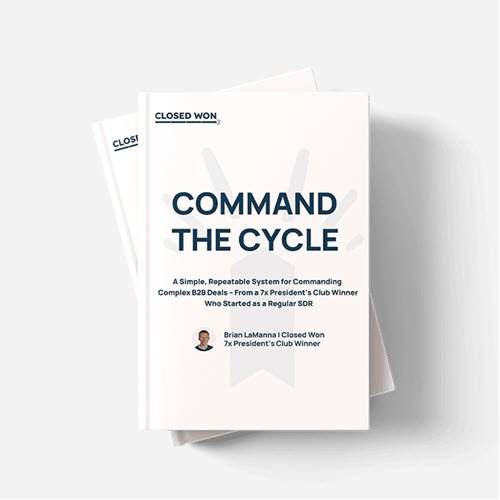
What Does Brian LaManna’s Command The Cycle Teach About B2B Sales?
B2B sales can become complicated quickly. A deal may involve multiple meetings, different decision-makers, procurement teams, security reviews, legal departments, pricing discussions, internal stakeholders, and several follow-ups before a contract is finally signed.
That is the problem Command The Cycle by Brian LaManna is designed to address.
CourseCanvass currently lists Command The Cycle as a 2026 Product Marketing course designed for entrepreneurs, marketers, product professionals, founders, consultants, and business owners who want to improve product positioning, understand customers, develop effective messaging, launch products, and build sustainable product-growth strategies.
Brian LaManna’s own description of the program is more specifically centered on managing a complete B2B deal cycle. He describes it as a practical playbook covering preparation, calls, follow-up, multithreading, building momentum, procurement, negotiation, internal coordination, and other activities that happen between sales calls.
What Is Command The Cycle?
Command The Cycle is a B2B sales and deal-management framework created by Brian LaManna.
The basic idea is that a sales representative should actively manage an opportunity throughout its entire lifecycle rather than treating each sales call as a separate event.
The framework covers the process from the first conversation through the final signature.
Its publicly described topics include:
- Preparing for sales calls
- Building a point of view before meetings
- Following up with prospects
- Multithreading accounts
- Creating momentum between meetings
- Identifying discovery gaps
- Building champions
- Coordinating internal teams
- Navigating procurement
- Working through security and legal processes
- Discussing pricing
- Negotiating
- Managing timelines
- Using AI throughout the process
LaManna described the original resource as a 94-page playbook containing the details needed to manage a deal from start to finish.
Who Is Brian LaManna?
Brian LaManna is a sales professional and the founder of Closed Won.
His public LinkedIn material describes Command The Cycle as the third major sales resource he launched in 2025, following Modern Outbound and Modern Discovery. He describes the material as being based on years of sales experience and focused on the parts of a deal that happen both during and between customer meetings.
His approach emphasizes practical execution rather than treating sales as only a collection of theories.
That practical focus is one of the defining characteristics of Command The Cycle.
What Does Command The Cycle Teach?
The program focuses on managing the different stages and activities involved in complex B2B opportunities.
1. Preparing for Sales Calls
Preparation is an important part of a successful sales process.
Before entering a meeting, sales professionals need to understand:
- Who they are speaking with
- What the prospect may care about
- What has already been discussed
- What the business problem may be
- What outcome the meeting should produce
- What the next step should ideally be
Command The Cycle emphasizes preparation and developing a point of view before customer conversations.
2. Building a Point of View
A salesperson should not always enter a meeting simply asking the prospect questions without context.
Building a point of view, or POV, means developing an informed perspective about the customer’s situation before the conversation.
This can help the salesperson enter the discussion with a clearer understanding of:
- Potential problems
- Business priorities
- Possible opportunities
- Relevant questions
- Areas requiring further discovery
The objective is to make sales conversations more purposeful.
3. Improving Discovery
Discovery is the process of understanding a prospect’s situation, problems, priorities, and desired outcomes.
Command The Cycle discusses discovery gaps and the importance of identifying information that is still missing from the deal.
Good discovery can help answer questions such as:
- What problem is the customer trying to solve?
- Why does the problem matter?
- Who is affected?
- What happens if nothing changes?
- Who is involved in the decision?
- What needs to happen before a purchase can occur?
These questions help salespeople understand the opportunity more completely.
4. Multithreading the Deal
One of the major concepts associated with Command The Cycle is multithreading.
Multithreading means building relationships with multiple relevant people within the same customer organization rather than depending on only one contact.
Complex B2B purchases can involve:
- Business leaders
- End users
- Managers
- Executives
- Finance
- Procurement
- Security
- Legal
- Technical teams
LaManna specifically highlights multithreading before and after meetings as part of the framework.
This can give a salesperson a broader understanding of the account and its decision-making process.
5. Building Momentum Between Calls
Sales activity does not stop when a meeting ends.
A deal can lose momentum if there is a long period without useful communication or progress.
Command The Cycle emphasizes strategic value touches between meetings.
Instead of simply sending repetitive “just checking in” messages, the idea is to provide something useful that helps the buyer move forward.
Examples could include:
- Relevant information
- A useful analysis
- A summary
- New findings
- Answers to outstanding questions
- Resources related to the customer’s problem
6. Following Up With Prospects
Follow-up is another major part of managing a deal.
Effective follow-up should ideally reinforce:
- What was discussed
- What matters to the buyer
- What remains unresolved
- What each side agreed to do
- What the next step is
Command The Cycle incorporates follow-up into the broader deal-management process rather than treating it as an isolated administrative task.
7. Building Champions
A champion is someone inside the prospective customer organization who supports the proposed solution and helps the salesperson navigate the buying process.
Building relationships with internal supporters can be particularly important in complex B2B sales.
Command The Cycle includes champion building among its described strategies.
The broader objective is to understand who supports the project, what they need, and how they can help move the opportunity forward.
8. Navigating Procurement, Security, and Legal
Complex B2B deals often involve more than the salesperson and buyer.
A deal may need to pass through:
- Procurement
- Security
- Legal
- Finance
- Compliance
- Vendor-management processes
Command The Cycle specifically addresses navigating procurement, security, and legal requirements.
This is important because an opportunity can appear commercially successful while still becoming delayed during internal approval processes.
9. Managing Timelines
A sales opportunity can remain open for too long when there is no clearly understood timeline.
Command The Cycle discusses driving timelines and identifying the next ideal step throughout the deal.
The goal is to maintain forward movement while understanding the customer’s actual decision process.
10. Pricing and Negotiation
Pricing conversations are another major part of the later stages of a B2B deal.
Salespeople may need to discuss:
- Pricing
- Budget
- Commercial terms
- Negotiation
- Procurement requirements
- Contract conditions
Command The Cycle includes pricing and negotiation among its core topics.
Understanding when and how to approach these conversations can help salespeople manage the commercial stage more deliberately.
11. Coordinating the Internal Team
A complex deal often requires more than one salesperson.
Depending on the product and customer, a sales team may involve:
- Account executives
- Sales engineers
- Customer success
- Product specialists
- Executives
- Marketing
- Legal
- Security
- Finance
Command The Cycle discusses orchestrating the internal team and using internal collaboration to support an opportunity.
This makes deal management partly an internal coordination challenge as well as an external sales activity.
12. Using AI Throughout the Deal Cycle
AI is another component of Command The Cycle.
LaManna specifically describes AI as being inserted into the various strategies covered by the framework to make sales activities more efficient.
AI can potentially assist with activities such as:
- Call summaries
- Follow-up drafts
- Research
- Preparation
- Organizing information
- Identifying missing information
- Creating sales-related content
The goal is not necessarily to replace the salesperson. Instead, AI can reduce repetitive work and give the salesperson more time for activities requiring human judgment.
Why Is Command The Cycle Useful?
The main usefulness of Command The Cycle comes from its focus on the entire deal, rather than only one part of the sales conversation.
A salesperson might be good at discovery but struggle with procurement.
Another salesperson might run strong demos but lose momentum afterward.
Someone else might have a good customer relationship but fail to build enough relationships across the buying committee.
Command The Cycle brings these activities together into one broader process.
This makes it particularly relevant to salespeople who manage multi-step B2B opportunities.
What Are the Benefits?
A more structured sales process
A repeatable framework can provide greater structure around how opportunities are managed.
Better preparation
Preparing before calls can help salespeople enter meetings with a clearer understanding of the account.
Stronger account relationships
Multithreading encourages salespeople to develop relationships with multiple stakeholders.
Better follow-up
A structured follow-up process can help maintain continuity between meetings.
Greater deal visibility
Looking at the complete cycle can make it easier to identify where an opportunity is currently stuck.
More effective use of AI
AI can assist with repetitive sales tasks such as recaps, research, and follow-up preparation.
Greater attention to the “off-call” work
One of the defining themes of the program is the work that happens between customer meetings. LaManna specifically describes this as an important part of the playbook.
Who Is Command The Cycle For?
Command The Cycle is most closely aligned with people involved in B2B and complex sales.
It may be relevant to:
- Account executives
- Enterprise sales representatives
- B2B sales professionals
- Sales managers
- Founders involved in sales
- Consultants
- Business-development professionals
- Customer-facing revenue teams
It is particularly relevant when a deal involves multiple meetings and stakeholders.
Someone selling a simple transactional product may not need the same level of deal-cycle management.
Is Command The Cycle Suitable for Beginners?
A beginner can learn useful concepts from Command The Cycle, but its subject matter is especially relevant to people who already participate in B2B sales.
The framework assumes that the learner understands basic sales concepts such as:
- Prospects
- Discovery
- Sales calls
- Buying committees
- Follow-ups
- Negotiation
- Closing
For someone completely new to sales, introductory sales training may be a useful starting point before applying a detailed deal-management framework.
What Makes Command The Cycle Different?
Command The Cycle is positioned around execution and deal management.
Brian LaManna’s own description emphasizes practical activities such as preparing for calls, following up, multithreading, building momentum, managing procurement, negotiating, and coordinating internal teams.
That gives the resource a practical orientation.
Instead of focusing only on general sales motivation or broad sales theory, it concentrates on the sequence of activities involved in moving an opportunity forward.
What Are the Limitations?
Command The Cycle is primarily oriented toward B2B deal management.
That means some concepts may be less relevant for:
- Low-ticket retail sales
- Simple transactional purchases
- Businesses without complex buying committees
- People who are completely new to sales
Another consideration is that the framework reflects Brian LaManna’s experience and approach. His professional results and career claims should be understood as his own reported experience rather than as independently verified evidence of what every learner will achieve. Public descriptions identify him with Gong and Closed Won, while performance claims such as President’s Club results are self-reported.
Most importantly, a sales framework cannot guarantee that a particular deal will close. Results depend on the product, market, customer, competition, pricing, timing, execution, and many other factors.
How Can Command The Cycle Help With B2B Sales?
A useful way to understand the framework is as a continuous process:
Prepare → Discover → Build Relationships → Create Momentum → Navigate Stakeholders → Manage Procurement → Negotiate → Close
The process does not necessarily move in a perfectly straight line.
A salesperson may need to return to discovery after learning something new.
A procurement issue may require another internal conversation.
A new executive stakeholder may change the buying process.
The framework therefore emphasizes active management of the deal rather than simply waiting for the next meeting.
What Skills Can You Develop?
Studying the framework can help learners develop knowledge around:
- B2B sales
- Deal-cycle management
- Sales discovery
- Account planning
- Multithreading
- Follow-up strategy
- Champion building
- Executive engagement
- Procurement navigation
- Sales negotiation
- Internal sales coordination
- Pipeline management
- AI-assisted selling
- Customer communication
- Complex deal management
These skills can be useful for sales professionals working on larger or multi-stage opportunities.
Where Can You Learn More About Command The Cycle?
The current CourseCanvass listing identifies Brian LaManna – Command The Cycle as a 2026 Product Marketing course.
Brian LaManna’s own public material also describes the resource and its focus on managing B2B deals from preparation through signature.
Final Thoughts
Command The Cycle by Brian LaManna focuses on one of the most important parts of complex B2B sales: what happens throughout the entire deal, not just during the sales call.
Its framework covers preparation, discovery, multithreading, follow-up, momentum, champion building, internal coordination, procurement, security, legal, pricing, negotiation, and AI-assisted workflows.
For sales professionals working with multi-step B2B opportunities, these areas provide a useful framework for thinking about how a deal progresses from its first conversation to a potential contract.
The central idea is straightforward: a deal needs to be actively managed throughout its entire cycle.
Brian LaManna – Command The Cycle
Command The Cycle by Brian LaManna (2026) is a premium Product Marketing course designed for entrepreneurs, marketers, product professionals, founders, consultants, and business owners who want to improve product positioning, understand customers, develop effective messaging, launch products, and build sustainable product growth strategies.
Frequently Asked Questions
What is Command The Cycle?
Command The Cycle is a B2B sales and deal-management playbook created by Brian LaManna. It focuses on managing opportunities from the first conversation through the signing stage.
Who created Command The Cycle?
Command The Cycle was created by Brian LaManna, a sales professional and founder of Closed Won.
What does Command The Cycle teach?
It covers sales preparation, discovery, follow-up, multithreading, champion building, deal momentum, procurement, security, legal, negotiation, internal coordination, and AI-assisted sales workflows.
Is Command The Cycle about B2B sales?
Yes. Its core framework is specifically focused on managing B2B sales opportunities and complex deal cycles.
What is multithreading in sales?
Multithreading means developing relationships with multiple relevant stakeholders within the same customer organization rather than depending on a single contact.
Does Command The Cycle cover AI?
Yes. Brian LaManna describes AI as being incorporated throughout the deal-management strategies to help salespeople work more efficiently.
Who can benefit from Command The Cycle?
It is particularly relevant to account executives, B2B salespeople, enterprise sellers, founders involved in sales, consultants, and other professionals managing multi-stage sales opportunities.
Is Command The Cycle suitable for beginners?
Beginners can learn from it, but the material is especially applicable to people who already understand basic sales concepts and are managing B2B opportunities.
What makes Command The Cycle different?
Its emphasis is on managing the complete deal cycle and the work that happens between customer meetings, including follow-up, multithreading, procurement, internal coordination, negotiation, and other activities.
Does Command The Cycle guarantee sales results?
No. A sales framework cannot guarantee a particular outcome. Results depend on factors such as the product, market, customer, competition, pricing, timing, and execution.