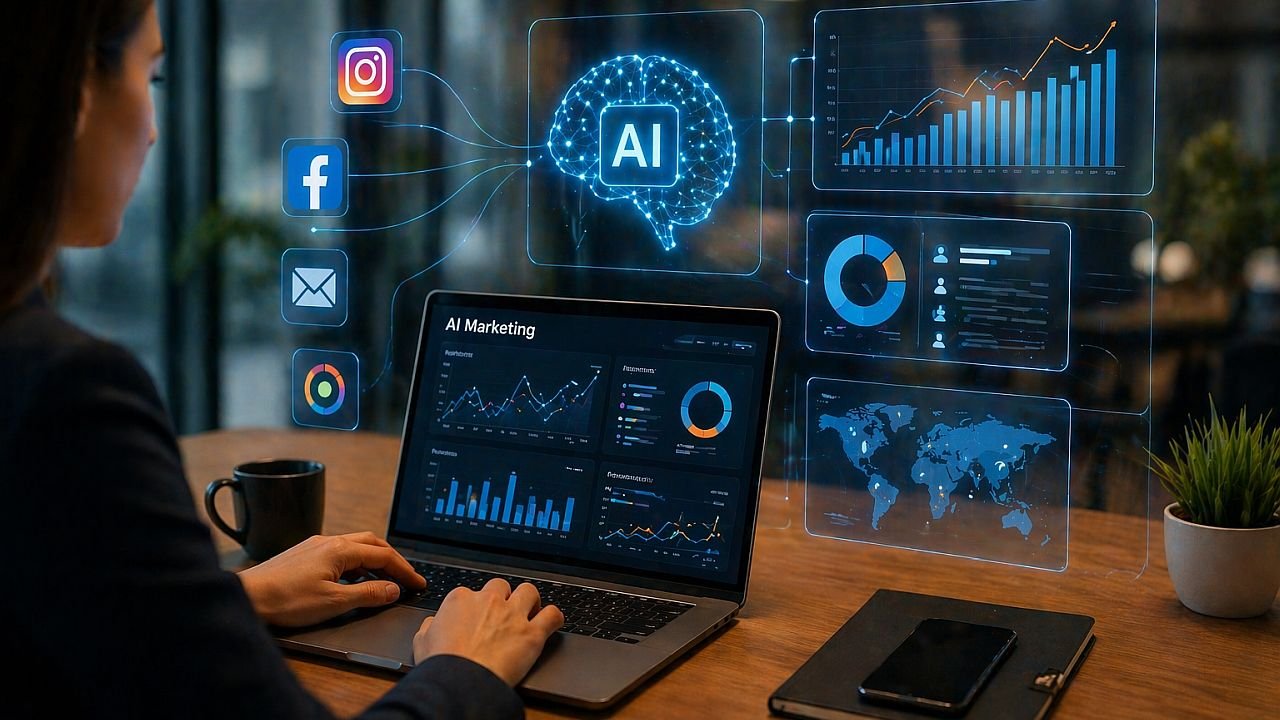
What Is AI Marketing and How Does It Work?
Artificial intelligence is changing how businesses understand customers, create marketing campaigns, analyze information, and make decisions. As AI technologies become more accessible, marketers can use them to process large amounts of information, automate repetitive work, personalize customer experiences, and improve marketing performance.
This approach is commonly known as AI marketing.
But what exactly is AI marketing, how does it work, why is it becoming important, and how can businesses and marketers use it effectively?
What Is AI Marketing?
AI marketing is the use of artificial intelligence technologies to support, automate, analyze, personalize, and improve marketing activities.
AI marketing can use technologies such as machine learning, natural language processing, predictive analytics, generative AI, and AI-powered automation to help marketers understand customer behavior and make better decisions.
Instead of relying entirely on manual analysis and repetitive processes, marketers can use AI to process information, identify patterns, generate insights, and assist with marketing activities.
Salesforce describes AI marketing as using AI to process data, identify patterns, make predictions, and perform tasks that would traditionally require human decision-making.
In simple terms:
AI marketing = Marketing + Artificial Intelligence + Data + Automation + Personalization
AI does not necessarily replace the marketer. Instead, it can help marketers work faster, analyze more information, and spend more time on strategy, creativity, and decision-making.
How Does AI Marketing Work?
AI marketing works by combining customer data, AI models, algorithms, and marketing systems to identify patterns and support marketing decisions.
A simplified process looks like this:
Collect Data → Analyze Data → Identify Patterns → Generate Insights → Take Action → Measure Results → Improve
For example, an online business may collect information about customer interactions with its website. An AI system can analyze those interactions to identify patterns in customer behavior.
The business can then use those insights to improve its marketing approach.
AI marketing can also automate certain actions. For example, an AI-powered system might help identify which customers are most likely to respond to a particular message or recommend when a customer should receive a follow-up.
Modern AI marketing can therefore combine analysis, prediction, content generation, automation, personalization, and optimization.
Why Is AI Marketing Important?
Marketing has become increasingly data-driven. Businesses can collect information from websites, applications, customer interactions, purchases, campaigns, and other digital touchpoints.
The challenge is turning all of that information into useful decisions.
AI can process large datasets much faster than a person working manually. It can identify patterns, make predictions, organize information, and help marketers respond to customers more efficiently.
IBM notes that AI is increasingly being used in marketing for customer insights, content creation, automation, data analysis, and improving customer experiences.
AI marketing is important because it can help businesses:
- Understand customers better
- Automate repetitive activities
- Personalize experiences
- Analyze marketing performance
- Identify trends
- Make faster decisions
- Improve efficiency
- Scale marketing operations
- Test and optimize campaigns
- Support long-term marketing strategy
What Are the Main Types of AI Used in Marketing?
AI marketing is not a single technology. It includes several different approaches that can serve different purposes.
Generative AI
Generative AI creates new content based on instructions and learned patterns.
Marketers can use it to assist with:
- Content ideas
- Marketing copy
- Email drafts
- Social media concepts
- Images
- Video concepts
- Product descriptions
- Research summaries
Human review remains important because AI-generated material can contain inaccuracies or fail to match a brand’s voice.
Predictive AI
Predictive AI analyzes historical and current data to estimate what may happen next.
For example, it can help identify customers who may be more likely to purchase, engage, or leave.
Predictive AI therefore helps marketers move from simply understanding what happened to making informed predictions about what might happen.
AI Automation
AI automation combines intelligence with automated workflows.
Instead of requiring a marketer to manually perform every step, an AI-enabled system can analyze information and trigger appropriate actions based on defined conditions.
IBM’s 2026 guidance describes AI marketing automation as going beyond traditional automation by adding AI-driven analysis and decision-making to marketing workflows.
AI Agents
AI agents represent a newer development in AI marketing.
Rather than performing one isolated task, an AI agent can potentially handle multiple connected steps using approved information, instructions, and tools.
For example, an agent might research information, organize findings, prepare recommendations, and assist with a marketing workflow while keeping humans involved in important decisions.
Machine Learning
Machine learning allows systems to identify patterns from data and improve their predictions or outputs over time.
In marketing, machine learning can support customer segmentation, recommendations, forecasting, optimization, and other data-driven activities.
How Do Businesses Use AI Marketing?
AI marketing can be applied across many parts of the marketing process.
Customer Analysis
AI can analyze customer information and identify patterns that may be difficult to detect manually.
This can help businesses understand customer interests, behaviors, and preferences.
Personalization
AI can help businesses provide more relevant experiences by using customer data to tailor messages, recommendations, and interactions.
For example, an online store may recommend different products to different customers based on their previous behavior.
Content Creation
Generative AI can help marketers brainstorm, draft, summarize, and adapt content.
However, the strongest approach combines AI assistance with human expertise, fact-checking, brand knowledge, and editorial judgment.
Marketing Automation
AI can help automate repetitive marketing processes and support workflows involving customers and campaigns.
This can reduce manual work and allow marketers to concentrate on higher-value activities.
Data Analysis
AI can analyze large quantities of marketing data and help identify trends, patterns, and potential opportunities.
This can make marketing analysis faster and more accessible.
Campaign Optimization
AI can help marketers evaluate campaign performance and identify opportunities for improvement.
Instead of waiting for manual analysis, marketers can use AI-powered systems to surface useful information more quickly.
Customer Support and Engagement
AI-powered conversational systems can help businesses respond to common customer questions and provide information.
More complex or sensitive situations can still require human involvement.
What Are the Benefits of AI Marketing?
AI marketing offers several potential advantages.
Greater Efficiency
AI can reduce the amount of time spent on repetitive activities.
This allows marketing teams to focus more heavily on strategy, creativity, and customer relationships.
Faster Data Analysis
AI can process large datasets quickly and identify patterns that may otherwise take significant manual effort to discover.
Better Personalization
AI can help businesses tailor experiences and messages according to customer behavior and preferences.
Improved Decision-Making
AI-generated insights can give marketers additional information when evaluating opportunities and making decisions.
Scalability
AI can help marketing teams handle larger amounts of information and content without increasing manual work at the same rate.
Improved Productivity
HubSpot’s 2026 research reports that marketers are increasingly using AI to reduce manual work and improve productivity.
Potential for Better ROI
When AI is implemented correctly, better targeting, automation, personalization, and optimization can contribute to more efficient marketing spending.
However, AI itself does not guarantee better results. The quality of the data, strategy, implementation, and human oversight still matter.
What Are the Challenges of AI Marketing?
AI marketing also comes with important challenges.
Data Privacy
Marketing systems often process customer information. Businesses need to handle that information responsibly and follow applicable privacy requirements.
Data Quality
AI systems depend heavily on the information they receive. Poor-quality or incomplete data can produce unreliable insights.
Accuracy
Generative AI can sometimes produce incorrect or misleading information. Human review remains important, particularly for factual, financial, legal, medical, or brand-sensitive content.
Lack of Human Context
AI can identify patterns but does not automatically understand every human emotion, cultural context, business situation, or customer relationship.
Bias
AI systems can reproduce or amplify biases present in their training data or inputs.
Over-Automation
Automating everything is not necessarily a good strategy. Some decisions require human judgment, creativity, empathy, and accountability.
Salesforce identifies privacy, security, data quality, technical expertise, and integration as important challenges businesses need to consider when implementing AI marketing.
What Skills Are Needed for AI Marketing?
AI marketing requires more than knowing how to use AI tools.
Important skills include:
- Marketing fundamentals
- Strategic thinking
- Data analysis
- Critical thinking
- Customer research
- AI literacy
- Prompting
- Content evaluation
- Communication
- Creativity
- Marketing analytics
- Automation
- Ethical AI use
- Adaptability
Marketers who understand both marketing principles and AI capabilities can make better decisions about when and how to use AI.
How Is AI Marketing Different From Traditional Marketing?
Traditional marketing can rely heavily on manual research, segmentation, content production, analysis, and campaign management.
AI marketing introduces intelligent technologies into these processes.
The difference can be summarized as:
Traditional approach: Human-led analysis and execution
AI-assisted approach: Human strategy supported by AI analysis, automation, prediction, and generation
AI marketing does not mean removing people from marketing. Instead, it changes how marketers work.
The most effective approach is often a combination of human creativity + human judgment + AI capabilities.
Can AI Replace Marketing Professionals?
AI is changing marketing roles, but that does not mean every marketing job can simply be replaced by AI.
AI is particularly useful for repetitive and data-heavy activities. Human professionals remain important for strategy, creativity, leadership, brand decisions, relationship building, ethical judgment, and understanding complex business situations.
Salesforce’s current guidance similarly emphasizes combining AI capabilities with human creativity and strategic expertise.
The future is therefore more likely to involve marketers working with AI rather than simply competing against it.
How Can Beginners Learn AI Marketing?
Beginners can approach AI marketing by first learning the fundamentals of marketing and then understanding how AI can support those activities.
A practical learning path is:
Learn Marketing Fundamentals → Understand AI Basics → Learn AI Marketing Applications → Practice With AI Tools → Analyze Results → Build Real Projects
Start by understanding customers, value propositions, positioning, marketing strategy, and measurement.
Then learn how AI can support analysis, content creation, personalization, automation, and optimization.
Practical projects are particularly useful because they allow learners to understand not only what AI tools can do, but also when they should and should not be used.
Why Are AI Marketing Courses Useful?
AI marketing courses can provide a structured way to learn an increasingly important combination of marketing and artificial intelligence.
A good course can help learners understand:
- AI marketing fundamentals
- AI marketing workflows
- Generative AI
- Marketing automation
- Customer analysis
- Personalization
- AI-powered content
- Marketing analytics
- Prompting
- AI tools
- Responsible AI use
Products by Category
-
Ad Creative Masterclass — Build Creatives That Scale 6–7 Figure Ad Spend
Original price was: $799.00.$40.00Current price is: $40.00. -
Ad Oven – AI Ad Factory + Ad Factory Dashboard
Original price was: $148.00.$23.00Current price is: $23.00. -
AI Emperor-AI Influencer Empire
Original price was: $49.99.$29.00Current price is: $29.00. -
Alex Gonzales – Set And Forget
Original price was: $1,500.00.$88.00Current price is: $88.00. -
Andy Skraga-How To Create Profitable Reels Using AI
Original price was: $197.00.$24.00Current price is: $24.00. -
Aryan Mahajan – AI BUSINESS FULL BUNDLE (2026)
Original price was: $297.00.$30.00Current price is: $30.00. -
CreativeLab – AI UGC ADS V2 2026
Original price was: $48.00.$36.00Current price is: $36.00. -
David Kollar-AI Fashion House Academy
Original price was: $59.00.$15.00Current price is: $15.00. -
Hugo Vardeblom – AI Ad Lab (2026)
Original price was: $97.00.$15.00Current price is: $15.00.








Courses can be particularly useful for marketers, entrepreneurs, business owners, students, freelancers, and professionals who want to develop modern marketing skills.
For learners who prefer structured education, exploring AI Marketing courses on CourseCanvass can be a practical next step.
What Is the Future of AI Marketing?
AI marketing is likely to become increasingly integrated into everyday marketing operations.
Current 2026 discussions point toward greater use of AI agents, predictive personalization, real-time customer insights, automated workflows, and AI-supported strategic decision-making.
Marketing may increasingly move toward systems that can understand customer context, recommend actions, generate personalized experiences, and automate connected workflows.
At the same time, privacy, transparency, accuracy, security, and human oversight will become increasingly important.
The future of AI marketing will therefore not simply be about using more AI. It will be about using AI more intelligently and responsibly.
Explore AI Marketing Courses
If you want to develop modern marketing skills and understand how artificial intelligence can support marketing, exploring AI Marketing courses can help you build knowledge in this rapidly evolving field.
CourseCanvass provides a place to discover courses across AI, marketing, business, technology, and other professional categories.
Final Thoughts
AI marketing is changing how businesses collect and analyze information, understand customers, create content, automate workflows, personalize experiences, and make marketing decisions.
Its biggest value comes from combining the speed and analytical capabilities of AI with human creativity, strategic thinking, judgment, and expertise.
For businesses, AI can create opportunities to become more efficient and responsive. For marketers, it creates a new set of skills and tools to learn.
The goal is not simply to use AI because it is popular. The goal is to understand where AI can genuinely improve marketing and how to use it responsibly.
FAQs About AI Marketing
What is AI marketing?
AI marketing is the use of artificial intelligence technologies to analyze data, understand customers, automate tasks, personalize experiences, generate content, and improve marketing decisions.
How does AI marketing work?
AI marketing generally works by collecting data, analyzing patterns, generating insights or predictions, taking or recommending actions, and measuring the results.
What are the main types of AI marketing?
Major approaches include generative AI, predictive AI, machine learning, AI automation, and increasingly AI agents.
What are the benefits of AI marketing?
AI marketing can improve efficiency, personalization, data analysis, productivity, scalability, and decision-making.
What are the challenges of AI marketing?
Major challenges include data privacy, poor data quality, inaccurate AI outputs, bias, security, integration difficulties, and excessive reliance on automation.
Can beginners learn AI marketing?
Yes. Beginners can learn AI marketing by studying marketing fundamentals, understanding AI concepts, practicing with AI tools, and applying their knowledge to real marketing projects.
Will AI replace marketers?
AI can automate many repetitive tasks, but human strategy, creativity, judgment, communication, and accountability remain important.
What skills are useful for AI marketing?
Marketing knowledge, AI literacy, data analysis, strategic thinking, creativity, critical thinking, communication, prompting, and ethical AI use are valuable skills.
Why should I learn AI marketing?
Learning AI marketing can help you understand how modern businesses use artificial intelligence to improve marketing workflows, customer experiences, analysis, personalization, and decision-making.
What is the future of AI marketing?
AI marketing is expected to become more personalized, automated, predictive, and integrated with AI agents and real-time customer data, while privacy and human oversight remain important.