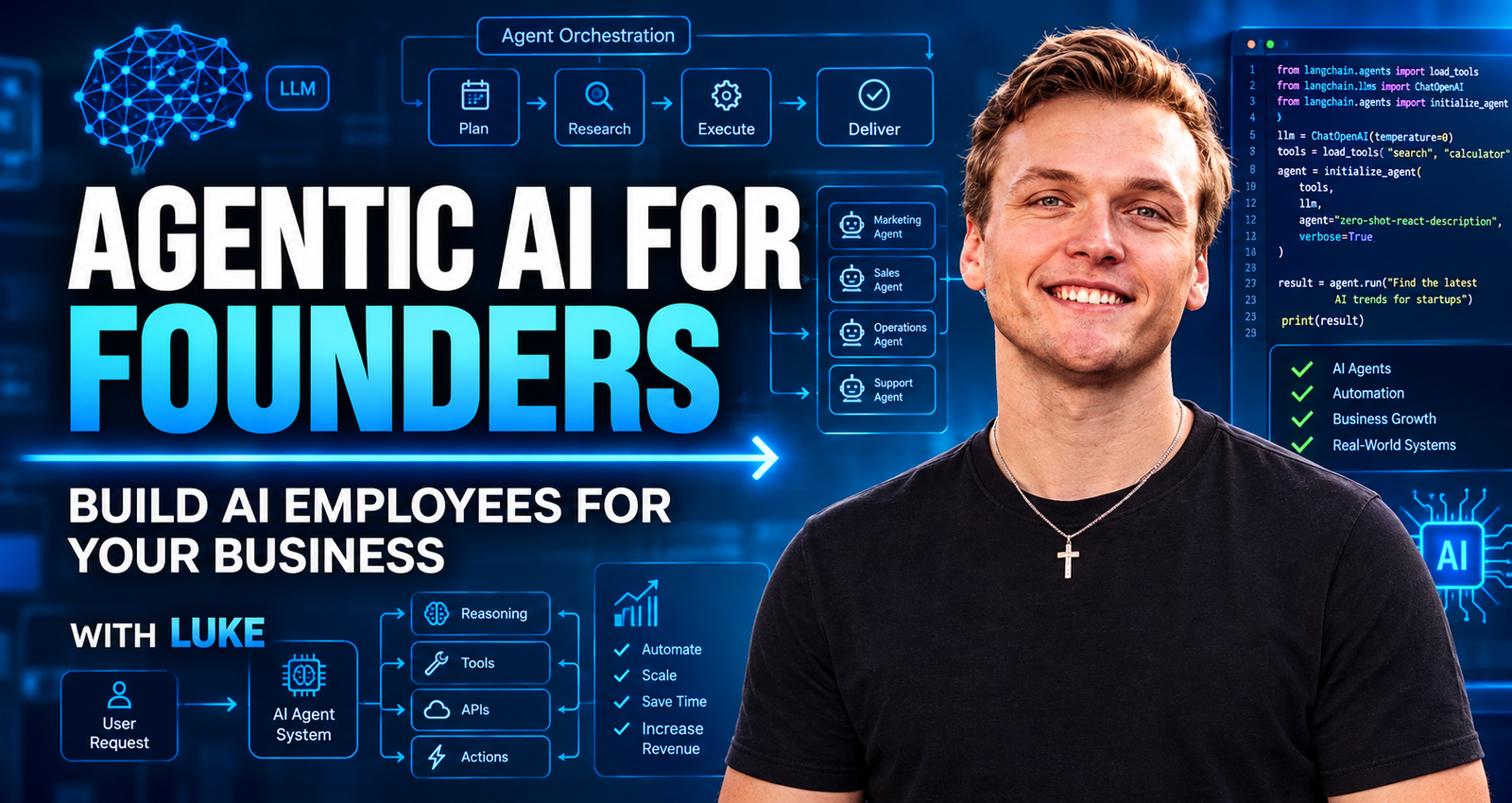
What Is Agentic AI for Founders and How Do AI Agents Work?
What Is Agentic AI?
Agentic AI refers to artificial intelligence systems designed to do more than simply respond to individual prompts. An AI agent can be given an objective, analyze information, use available tools, make decisions within defined boundaries, and carry out multiple steps toward completing a task.
Traditional generative AI is often used for individual activities such as writing text, summarizing information, answering questions, or generating ideas. Agentic AI extends this concept by connecting AI capabilities with tools, data, workflows, and actions.
For founders, this creates opportunities to build systems that can assist with repetitive business processes instead of requiring every task to be completed manually.
For example, an AI agent could receive a business request, analyze the information, retrieve relevant data, prepare an output, and pass the result to another system. The exact capabilities depend on the tools, permissions, instructions, and workflow surrounding the agent.
How Do AI Agents Work?
An AI agent generally operates through several connected components.
First, the agent receives a goal or task. It then processes available information and determines which actions are appropriate based on its instructions and available tools.
The agent may interact with external applications through APIs, databases, automation platforms, or other software. After completing one step, it can evaluate the resulting information and continue to the next step when the workflow allows it.
A simplified agentic workflow might look like this:
Goal → Understand → Plan → Use Tools → Perform Actions → Check Results → Continue or Complete
This differs from a simple chatbot interaction because the agent can potentially participate in a sequence of actions rather than producing only one response.
Who Is Luke Cutting?
Luke Cutting is associated with educational material focused on applying artificial intelligence to entrepreneurship, business processes, and modern workflows.
His Agentic AI for Founders course focuses on the practical relationship between AI agents and entrepreneurship. Rather than treating AI as only a content-generation technology, the course approaches AI from the perspective of how founders can use intelligent systems to support business activities.
The founder-focused approach is particularly relevant as AI tools increasingly move from simple assistants toward systems capable of handling connected tasks and workflows.
What Is Agentic AI for Founders?
Agentic AI for founders refers to applying AI-agent technology to the practical challenges involved in building and operating a business.
Founders often have to manage multiple areas simultaneously, including research, customer communication, marketing, operations, administration, sales, and strategic planning. Some of these activities involve repetitive digital processes that can potentially be assisted or automated.
AI agents can become useful when they are connected to the right tools and given clear instructions and boundaries.
Instead of asking an AI system to complete one isolated task, a founder can design a workflow where an agent participates in several connected stages.
Why Is Agentic AI Useful for Founders?
One major advantage of agentic AI is its potential to reduce repetitive manual work.
Consider a lead-management process. A conventional process might require a person to check incoming information, organize it, identify relevant details, update a CRM, and prepare follow-up information.
An AI-powered system could potentially assist with several of these steps. It could interpret incoming information, classify it according to predefined criteria, structure the data, and trigger appropriate workflow actions.
Agentic AI can also support research, content workflows, customer support, internal operations, and information management.
However, automation should be designed carefully. AI agents can make errors, misunderstand instructions, or produce incorrect results. Human review remains important for sensitive or high-impact business decisions.
Luke Cutting-Agentic AI for Founders
Agentic AI for Founders by Luke Cutting (June 2026) is a premium AI Automation course designed for founders, entrepreneurs, business owners, operators, and startup teams who want to use AI agents and automation systems to streamline workflows, improve productivity, reduce repetitive work, and build scalable business operations.
AI Agents and Business Automation
AI agents and business automation can work together to create more sophisticated workflows.
Traditional automation is generally rule-based. If one event occurs, a predefined action takes place.
AI agents can introduce an additional layer of interpretation. For example, instead of simply moving every incoming message to the same destination, an AI system can analyze the message and determine which predefined workflow is relevant.
This can make automation more flexible, especially when businesses receive information in different formats.
A founder might use AI automation for:
- Lead processing
- Customer-support workflows
- Market research
- Content operations
- Data organization
- Internal knowledge management
- Email and communication workflows
- Sales-support processes
- Administrative tasks
- Business reporting
The specific implementation depends on the business, available tools, and level of human oversight required.
What Can Founders Automate With AI Agents?
There are many potential applications for AI agents in modern businesses.
Research: An agent can assist with collecting, organizing, and summarizing information from approved sources.
Lead Management: AI can help process incoming lead information and organize it according to predefined criteria.
Content Workflows: Agents can assist with research, drafting, repurposing, and organizing content.
Customer Support: AI systems can classify questions, retrieve relevant information, and assist with customer responses.
Operations: Repetitive administrative processes can potentially be connected through workflow automation.
Knowledge Management: AI agents can help retrieve information from connected business knowledge bases and documents.
Agentic AI vs Traditional Automation
Traditional automation and agentic AI are related but different.
Traditional automation typically follows explicit rules. The workflow designer determines what happens when a particular condition occurs.
Agentic AI can add a reasoning and interpretation layer to the process. The AI system can analyze information and select among available actions within its defined boundaries.
For example, a traditional workflow might say:
If a form is submitted → send an email.
An agentic workflow could involve:
Receive form → interpret the request → identify the relevant category → retrieve information → prepare an appropriate response → trigger the next workflow.
This does not mean that agentic AI should replace traditional automation. In many cases, the two approaches can work together.
What Does Luke Cutting’s Agentic AI for Founders Course Offer?
Luke Cutting’s Agentic AI for Founders is designed around understanding the opportunities created by AI agents and agentic workflows from a founder’s perspective.
The course provides a business-oriented context for exploring how AI can become part of workflows rather than remaining an isolated productivity tool.
For entrepreneurs interested in AI automation, the course can help connect concepts such as AI agents, business workflows, automation, productivity, and scalable systems.
Why Learn Agentic AI?
AI development is moving toward increasingly capable systems that can interact with tools and perform multi-step tasks. Understanding how these systems work can help founders make more informed decisions about where AI automation may fit within their businesses.
The most useful starting point is not simply asking, “What can AI do?” Instead, founders can examine their existing processes and identify repetitive activities where AI and automation could provide practical assistance.
This approach can lead to more purposeful AI implementation and reduce the risk of adopting AI tools without a clear business use case.
Final Thoughts
Agentic AI represents an evolution from using AI for individual tasks toward building systems capable of working through multiple connected steps.
For founders, the technology can be relevant to areas such as research, customer communication, lead management, content operations, productivity, and business automation.
Luke Cutting’s Agentic AI for Founders focuses on this intersection between AI agents and entrepreneurship, making the topic relevant to anyone exploring how intelligent automation can become part of modern business workflows.
As with any AI system, successful implementation requires clear objectives, appropriate permissions, reliable workflows, and human oversight where necessary. The goal is not simply to automate everything, but to identify where AI agents can provide useful support within a well-designed business process.
FAQs
What is agentic AI?
Agentic AI refers to AI systems designed to pursue defined objectives through multiple steps, potentially using tools, information sources, and connected applications to complete tasks.
How do AI agents work?
AI agents receive a goal, process information, determine appropriate actions within their instructions and permissions, use connected tools when available, and continue through a workflow toward completing the task.
What is Agentic AI for Founders?
Agentic AI for Founders refers to applying AI-agent technology to entrepreneurial activities such as business operations, research, productivity, customer support, marketing, and workflow automation.
Who is Luke Cutting?
Luke Cutting is associated with educational content focused on applying AI and modern technology to entrepreneurship and business workflows. His Agentic AI for Founders course focuses on AI agents from a founder-oriented perspective.
What can AI agents automate?
AI agents can potentially assist with research, lead processing, content workflows, customer support, data organization, administrative tasks, and other digital processes, depending on their tools and configuration.
What is the difference between AI agents and traditional automation?
Traditional automation generally follows predefined rules, while AI agents can add an AI-based interpretation and decision layer within defined boundaries. The two technologies can also be combined.
Is agentic AI useful for small businesses?
Agentic AI can potentially support small businesses by assisting with repetitive digital processes and workflows. Its usefulness depends on the business’s specific processes, tools, data, and automation requirements.
Can AI agents work without human supervision?
The level of autonomy depends on how an AI agent is designed and what permissions it receives. Human oversight is important for sensitive, complex, or high-impact tasks because AI systems can make mistakes.