What Can You Learn From Tony Teegarden’s Deals Over Clients 2026?
Focus Keyword: Tony Teegarden Deals Over Clients
Secondary Keywords: Deals Over Clients 2026, Tony Teegarden, Deals Over Clients, Revenue Share Deals, Partnership Deals, Performance-Based Partnerships, Client Acquisition, Freelancing, Agency Growth, High Ticket Sales, Deal Making, Revenue Sharing, Business Partnerships, Partnership Marketing, Performance Marketing, Sales Partnerships, Online Business, Client Work
Permalink:tony-teegarden-deals-over-clients
SEO Title:
Tony Teegarden Deals Over Clients 2026: What Can You Learn?
Meta Description:
Discover what Tony Teegarden’s Deals Over Clients 2026 teaches about partnership deals, revenue sharing, deal making, finding partners, campaign strategy, and moving beyond traditional client work.
Category: High Ticket Sales
Tags:
Tony Teegarden, Deals Over Clients, Deals Over Clients 2026, Revenue Share Deals, Partnership Deals, Deal Making, Performance-Based Partnerships, Revenue Sharing, High Ticket Sales, Client Acquisition, Freelancing, Agency Growth, Sales Partnerships, Partnership Marketing, Performance Marketing, Business Partnerships, Online Business, Sales Strategy
Featured Image:
Use the official Deals Over Clients course/community artwork featuring Tony Teegarden. The current Skool listing identifies the community as “Deals Over Clients” and Tony Teegarden as its owner.
What Is Tony Teegarden’s Deals Over Clients?
Deals Over Clients is Tony Teegarden’s business model and training community built around moving away from traditional client-service relationships and toward partnership-based deals.
The core idea is that instead of being paid a fixed fee or monthly retainer for delivering services, a marketer or freelancer can partner with an existing business and participate in the revenue generated by a campaign.
Tony describes this as moving from being an expense for a client to becoming a revenue-generating partner. His current materials focus on finding businesses with underused assets, testing partnership opportunities, and structuring agreements around performance.
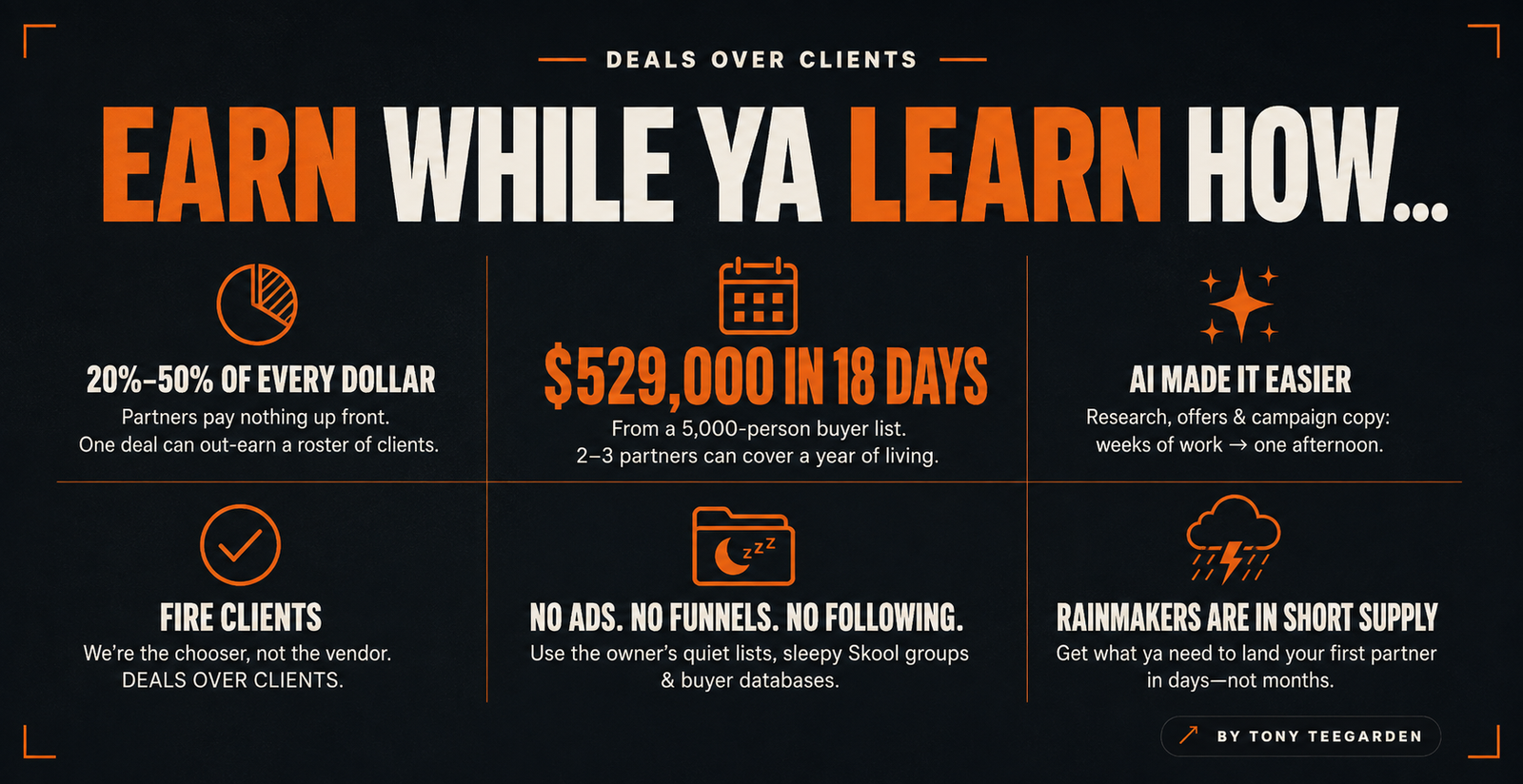
The current Deals Over Clients community describes a model in which members can potentially earn a percentage of campaign revenue while partners pay nothing upfront. The community currently states a 20%–50% revenue-share range, although actual deal economics depend on the specific partnership and agreement.
Who Is Tony Teegarden?
Tony Teegarden presents himself as an investor and rainmaker focused on creating high-ticket sales through partnerships.
His current Skool profile describes him as someone who adds new high-ticket sales for coaches, influencers, and course creators.
Tony says his transition away from traditional client work began after spending time with mentor Travis Sago in 2015.
According to Tony’s own account, that experience led him to focus on partnership deals rather than relying primarily on client retainers. His current Deals Over Clients materials continue to center on that philosophy.
What Can You Learn From Deals Over Clients?
The training and community focus on several major areas:
- Finding potential business partners
- Identifying underused business assets
- Structuring partnership deals
- Revenue-share arrangements
- Campaign creation
- Offer development
- Partner qualification
- Deal evaluation
- Outreach
- Sales messaging
- AI-assisted research
- Campaign copywriting
- Performance-based marketing
- Moving away from traditional client work
The current community specifically highlights partner acquisition, revenue-share deals, existing business assets, AI-assisted research and campaign copy, and building partnerships without upfront client fees.
How Does the Deals Over Clients Model Work?
The model can broadly be understood as a shift from client → service provider to partner → revenue-sharing dealmaker.
Traditional Client Model
A freelancer or agency typically:
- Finds a client.
- Proposes services.
- Agrees on a fee.
- Performs the work.
- Delivers the agreed service.
- Gets paid.
The relationship is primarily based on deliverables.
Partnership Model
Deals Over Clients takes a different approach:
- Identify a potential partner.
- Find an underused opportunity or asset.
- Discuss a potential campaign.
- Agree on the economics.
- Run a test.
- Generate revenue.
- Share the resulting revenue according to the agreement.
The emphasis is therefore on performance and upside rather than simply billing for hours or deliverables.
What Are Revenue-Share Deals?
Revenue-share deals involve two or more parties agreeing to divide revenue generated by a particular activity or campaign.
For example, a marketer might help an established business monetize an underused email list.
Instead of charging a traditional project fee, the marketer and business could agree to share revenue generated by the campaign.
The exact percentage, expenses, responsibilities, tracking, refund treatment, payment timing, and duration should always be clearly defined in a written agreement.
Tony’s current community describes revenue-share percentages of 20%–50% as part of its model.
How Can Existing Business Assets Become Opportunities?
A central concept in Deals Over Clients is finding assets that a business already owns but is not fully using.
Examples discussed in Tony’s current materials include:
- Email lists
- Buyer databases
- Online communities
- Existing audiences
- Course libraries
- Existing customer relationships
Tony describes these as underutilized assets that can potentially be activated through a well-designed campaign.
The important point is that the partnership does not necessarily require the dealmaker to build an audience from scratch.
How Do You Find Potential Partners?
Partner selection is an important part of the model.
Tony’s current Deals Over Clients materials discuss identifying businesses that already have valuable assets but may not be actively monetizing them.
Potential partners might include:
- Course creators
- Coaches
- Influencers
- Consultants
- Online businesses
- Established service businesses
- Businesses with existing customer databases
The goal is not simply to find anyone willing to work together.
The focus is finding a situation where both parties can benefit from a specific revenue opportunity.
Why Is Partner Selection Important?
Not every business is a good candidate for a partnership.
A strong opportunity may require:
- A legitimate offer
- An existing audience
- A suitable customer base
- A clear monetization opportunity
- A trustworthy partner
- Reliable tracking
- Reasonable economics
Tony’s current materials emphasize being selective about opportunities rather than accepting every possible deal. His public writing describes saying no to many potential deals before choosing the partnerships he wants to pursue.
What Does the “Deals Over Clients” Philosophy Mean?
The philosophy can be summarized as:
Stop trying to be hired for every project and start looking for opportunities where your skills can participate in the upside.
Instead of asking:
“What service can I sell?”
The model encourages asking:
“What valuable opportunity can I help create with the right partner?”
That changes the relationship from a conventional vendor arrangement toward a partnership.
How Does Campaign Testing Fit Into the Model?
Testing is another important component.
Instead of committing substantial resources immediately, a partnership can begin with a smaller campaign or test.
The goal is to determine whether the opportunity has real potential before expanding it.
Tony’s current materials describe short tests and campaigns built around existing assets rather than requiring a large upfront marketing operation.
Testing can help both sides evaluate:
- Audience response
- Offer strength
- Campaign performance
- Revenue potential
- Operational fit
How Does AI Fit Into Deals Over Clients?
AI is increasingly incorporated into Tony’s current model.
The Deals Over Clients community specifically states that AI can make research, offer creation, and campaign copy faster.
AI can potentially assist with:
- Market research
- Partner research
- Offer analysis
- Campaign ideas
- Copywriting
- Email drafting
- Data organization
- Deal analysis
- Documentation
However, AI does not replace the relationship-building and judgment required to decide whether a partnership is actually worthwhile.
What Can You Learn About Sales?
The model naturally develops sales-related skills.
Rather than selling a fixed package, you need to communicate a business opportunity.
That requires understanding:
- The partner’s goals
- The existing assets
- The potential opportunity
- The campaign
- The economics
- The risks
- The expected responsibilities
This is closer to consultative selling and deal making than traditional service pitching.
What Are the Benefits?
Less Dependence on Hourly Billing
Revenue-sharing arrangements can potentially reduce dependence on billing for hours or fixed deliverables.
Potential for Greater Upside
If a campaign performs strongly, a percentage-based arrangement can produce more revenue than a fixed project fee.
Existing Assets
The model focuses heavily on monetizing assets that businesses already possess.
Performance Alignment
Both parties can have a common interest in generating revenue.
Repeatable Partnerships
A successful campaign may potentially be repeated or expanded.
AI-Assisted Workflows
AI can reduce the time required for research, offer development, and copywriting according to the current community’s description.
Who Is Deals Over Clients For?
The program may be especially relevant to:
- Freelancers
- Copywriters
- Marketers
- Agency owners
- Consultants
- Course creators
- Online-business operators
- Sales professionals
- Performance marketers
Tony’s current Deals Over Clients materials specifically identify freelance copywriters, content creators, online marketers, agency owners, course sellers, coaches, and information-product marketers as audiences for the model.
Is It Useful for Freelancers?
Freelancers are one of the clearest audiences for the concept.
Traditional freelancing often means:
Find client → sell service → deliver work → invoice → repeat.
Deals Over Clients proposes an alternative:
Find partner → identify opportunity → structure deal → generate revenue → participate in upside.
This does not mean traditional freelancing is inherently bad. Rather, the course presents partnership deals as another business model that freelancers can explore.
Is It Useful for Copywriters?
Yes.
Copywriters can potentially apply their existing skills to revenue-generating campaigns rather than selling copywriting exclusively as a fixed deliverable.
Tony’s current writing specifically discusses moving copywriters from being “hired pens” toward partnership deals.
A copywriter may therefore bring skills such as:
- Email writing
- Sales copy
- Offer messaging
- Campaign strategy
- Conversion-focused writing
into a partnership arrangement.
What Makes Deals Over Clients Different?
The biggest difference is the economic relationship.
A conventional service business primarily sells work.
Deals Over Clients emphasizes participating in the value created by the work.
That distinction can be significant.
Instead of:
“Pay me $X to write these emails.”
The model explores:
“Let’s structure a deal where my compensation is connected to the revenue those emails generate.”
The second arrangement can provide greater upside, but it also introduces additional uncertainty and requires careful agreements.
What Are the Limitations?
Revenue-share partnerships are not guaranteed income.
Potential challenges include:
- Campaigns may fail.
- Partners may disagree.
- Revenue can fluctuate.
- Attribution can become complicated.
- Refunds may affect calculations.
- Payment terms need to be clear.
- Partners must trust each other.
- Not every business has a suitable asset.
- Deal negotiation can take time.
- Results depend on the offer, audience, execution, and market.
Tony himself acknowledges that some tests fail and that he rejects many potential deals.
Therefore, Deals Over Clients should not be viewed as a guaranteed replacement for employment or client work.
What Skills Can You Develop?
The approach can help develop skills in:
- Deal making
- Partnership development
- Revenue-share negotiation
- Sales
- Offer creation
- Campaign strategy
- Email marketing
- Direct-response copywriting
- Partner research
- Business analysis
- Performance marketing
- AI-assisted marketing
- Opportunity evaluation
These skills can be useful beyond revenue-share partnerships.
Where Can You Learn More?
Tony’s current Deals Over Clients community is hosted on Skool. The current public listing shows the community as private, with 300+ members and a listed price of $97/month.
Tony also publishes a Deals Over Clients newsletter containing deal-making articles, frameworks, case studies, prompts, and partnership-focused material.
For CourseCanvass readers, the program is best positioned as a partnership and high-ticket deal-making education rather than a traditional freelance or agency course.
Final Thoughts
Tony Teegarden’s Deals Over Clients 2026 presents a different way of thinking about online business.
Instead of focusing exclusively on acquiring more clients, the model asks entrepreneurs to look for businesses with valuable but underused assets and explore partnerships where both sides participate in the resulting revenue.
The approach is especially interesting for freelancers, copywriters, marketers, consultants, and agency owners who already have valuable skills but want to explore a different economic model.
Its biggest idea is simple:
Don’t only sell your time. Look for opportunities where your skills can participate in the upside.
At the same time, revenue-share partnerships require careful partner selection, clear agreements, reliable tracking, and realistic expectations. The model can offer upside, but it also carries more uncertainty than a guaranteed project fee.
For someone interested in moving beyond traditional client work, Deals Over Clients provides a framework for thinking about partnerships, performance-based compensation, and deal making from a different perspective.

Tony Teegarden – Deals Over Clients 2026
Tony Teegarden – Deals Over Clients 2026 is a high-ticket sales training program focused on deal creation, prospect qualification, value communication, sales conversations, objection handling, negotiation, and closing. Designed for entrepreneurs, agencies, consultants, and sales professionals, it explores a structured approach to pursuing and converting valuable business opportunities.
FAQs
What is Deals Over Clients?
Deals Over Clients is Tony Teegarden’s business education and community focused on moving from traditional client work toward partnership and revenue-share deals.
Who is Tony Teegarden?
Tony Teegarden is an investor and rainmaker who focuses on partnership-based campaigns and high-ticket sales. His current Skool profile describes him as adding high-ticket sales for coaches, influencers, and course creators.
What does Deals Over Clients teach?
It focuses on finding partners, identifying underused assets, structuring deals, creating campaigns, generating sales, and participating in revenue rather than relying exclusively on client fees.
What are revenue-share deals?
Revenue-share deals are arrangements in which partners receive an agreed percentage of revenue generated by a particular campaign or business activity.
What percentage can a dealmaker receive?
The current Deals Over Clients community states that members can earn 20%–50% of campaign revenue, although actual terms depend on the individual agreement.
Does Deals Over Clients require running paid ads?
The current community describes a model based on existing assets such as email lists, communities, and buyer databases and says the approach does not require ads, funnels, or an existing following.
Can freelancers use the Deals Over Clients model?
Yes. Freelancers are one of the primary audiences discussed in Tony’s current materials, particularly copywriters and marketers who want to move beyond traditional client retainers.
Can copywriters benefit from the model?
Yes. Tony specifically discusses applying partnership economics to copywriting and moving from being paid simply for writing toward participating in the revenue generated by campaigns.
Does Deals Over Clients use AI?
Yes. The current community describes using AI for research, offer development, and campaign copywriting.
Is Deals Over Clients guaranteed to make money?
No. Revenue-share deals depend on the partner, offer, audience, campaign, market, execution, and agreement. Tony’s own materials acknowledge that some tests fail and that many potential deals are rejected.
What is the main idea behind Deals Over Clients?
The central idea is to move from being paid primarily for client services toward creating partnership deals where compensation is connected to the revenue generated.