
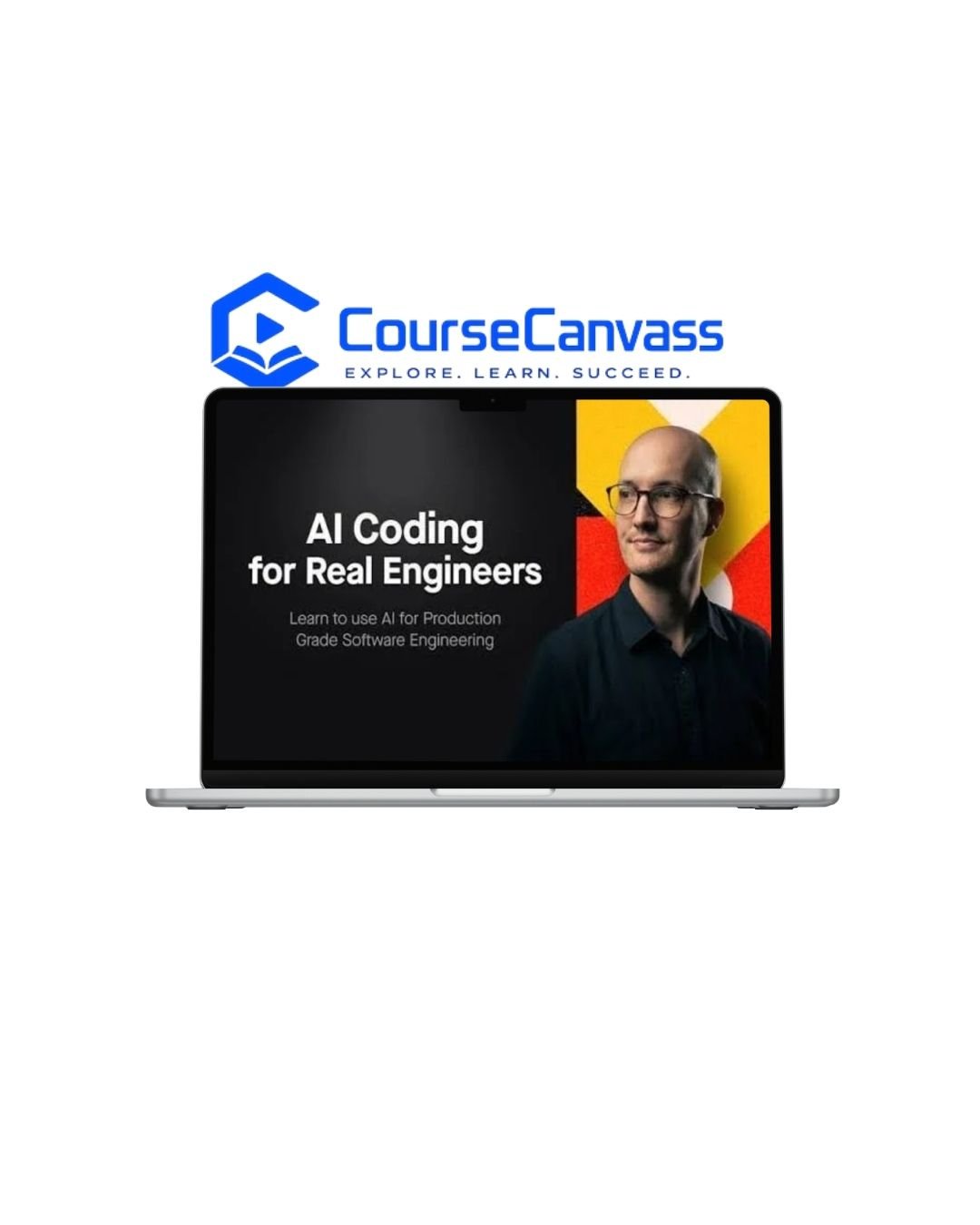
Matt Pocock – AI Coding for Real Engineers (2026)
Original price was: $497.00.$23.00Current price is: $23.00.
Interested in purchasing this course?Contact us directly to receive your payment link. 🟢 Get Payment Link on WhatsApp
AI Coding for Real Engineers by Matt Pocock (2026) is a premium AI Coding course designed for software engineers, developers, programmers, and technical professionals who want to use artificial intelligence effectively for coding, debugging, testing, refactoring, code review, and modern software development workflows.
Description
Course Overview
AI Coding for Real Engineers by Matt Pocock is a comprehensive AI Coding course focused on helping software engineers and developers integrate artificial intelligence into practical software development workflows. The program explores how AI coding tools can support programming, debugging, code generation, testing, refactoring, documentation, code review, and technical problem-solving while keeping engineers responsible for architecture, quality, and final decisions.
Artificial intelligence is changing how software is written and maintained. Modern coding assistants can generate code, explain unfamiliar implementations, identify potential problems, create tests, and accelerate repetitive development tasks. However, effective AI-assisted development requires more than knowing how to generate a code snippet. Engineers need to understand how to provide useful context, evaluate AI output, identify mistakes, and maintain control over the development process.
The program begins with the fundamentals of AI-assisted software development. Students explore how AI coding tools can fit into existing engineering workflows and where they can provide the greatest productivity benefits. Understanding these capabilities helps developers use AI as an engineering assistant rather than blindly accepting generated code.
A major focus of the curriculum is AI-powered code generation. Participants learn how to use AI to accelerate implementation, explore solutions, generate boilerplate, and work through programming problems. Effective workflows involve giving AI sufficient context and clearly defining technical requirements so generated code is more useful and easier to evaluate.
The course also emphasizes prompting and context management for coding. Learners discover how instructions, project context, existing code, requirements, and constraints can influence AI-generated results. Providing relevant information can help developers obtain more accurate and maintainable outputs.
Debugging is another important component of the training. Students explore how AI can assist with understanding error messages, investigating unexpected behavior, identifying possible causes, and suggesting potential fixes. Engineers still need to reproduce problems and verify solutions, but AI can accelerate the investigative process.
The curriculum also covers testing and test generation. Participants can use AI to help create test cases, identify edge cases, improve test coverage, and reason about expected behavior. Testing provides an important verification layer for AI-generated code and helps developers detect problems before changes reach production.
Code review and refactoring receive significant attention throughout the learning experience. Learners explore how AI can help identify code smells, suggest improvements, explain complex sections, and restructure code while preserving intended behavior. Human review remains essential because generated recommendations must be evaluated against project requirements and architecture.
The program also examines software documentation. AI can assist with explaining existing code, drafting documentation, generating comments, summarizing implementations, and helping developers understand unfamiliar codebases. These capabilities can reduce repetitive documentation work and make technical information easier to maintain.
AI-assisted development can also support learning and problem-solving. Students can use AI to explore unfamiliar APIs, understand technical concepts, compare implementation approaches, and break complex programming tasks into smaller steps. This can make research and experimentation more efficient while encouraging engineers to verify technical claims independently.
The course also addresses engineering judgment and AI limitations. AI-generated code can contain errors, misunderstand requirements, introduce security problems, or use inappropriate approaches. Developers therefore need strong fundamentals and careful review processes to determine whether generated solutions are actually suitable.
Security, maintainability, and code quality are important considerations throughout AI-assisted development. Learners are encouraged to avoid exposing sensitive information, review generated dependencies and code, consider potential vulnerabilities, and ensure that AI-assisted changes meet appropriate engineering standards.
Whether you’re a professional software engineer, full-stack developer, programmer, technical lead, or developer looking to modernize your workflow, AI Coding for Real Engineers by Matt Pocock (2026) provides practical frameworks for incorporating AI into everyday software development.
By combining AI-assisted coding, code generation, prompt engineering, debugging, testing, refactoring, code review, documentation, technical problem-solving, and responsible AI development practices, AI Coding for Real Engineers equips learners with practical skills for working more effectively with AI-powered development tools.
Related products
-
Sale!

Jonathan Mast-AI Image-to-Income
Original price was: $17.00.$8.00Current price is: $8.00. -
Sale!
Caleb Curry – Software Engineering Mastery Bundle
Original price was: $1,997.00.$87.00Current price is: $87.00. -
Sale!
Mihail Eric-AI Software Development
Original price was: $297.00.$24.00Current price is: $24.00. -
Sale!
Eben Pagan-A.I. Builder Bootcamp
Original price was: $497.00.$24.00Current price is: $24.00.

Reviews
There are no reviews yet.