
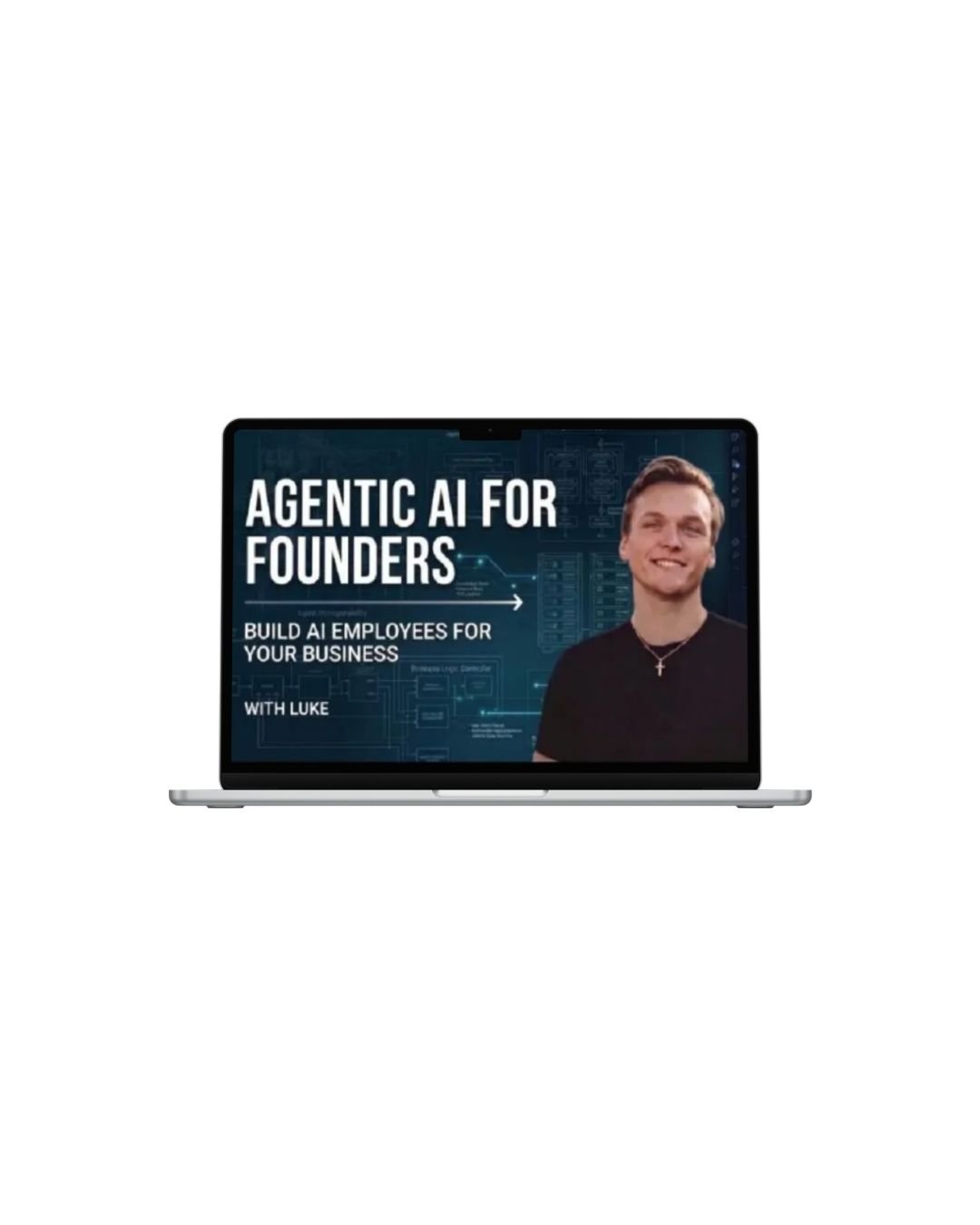
Luke Cutting – Agentic AI for Founders (2026)
Original price was: $97.00.$22.00Current price is: $22.00.
Interested in purchasing this course?Contact us directly to receive your payment link. 🟢 Get Payment Link on WhatsApp
Learn how to use agentic AI, intelligent agents, and workflow automation to streamline startup operations, boost productivity, and scale your business with Luke Cutting – Agentic AI for Founders (2026).
Description
Course Overview
Luke Cutting – Agentic AI for Founders (2026) focuses on the growing role of agentic artificial intelligence in entrepreneurship, startup development, and modern business operations. As AI technology continues to evolve, founders have new opportunities to automate repetitive work, streamline workflows, improve operational efficiency, and build businesses that can scale more effectively. This course explores the potential of AI agents and how entrepreneurs can approach this emerging technology to support their business goals.
Agentic AI represents a shift from traditional AI tools that primarily respond to individual prompts toward systems that can work through multi-step tasks, use connected tools, and pursue defined objectives with varying degrees of autonomy. For founders, this creates opportunities to rethink how everyday business activities are managed, from research and planning to customer support, content production, internal operations, and workflow coordination.
What You’ll Explore
Discover the fundamentals of agentic AI and understand how AI agents differ from conventional AI assistants and rule-based automation tools. Explore how these systems can interpret instructions, break larger objectives into smaller tasks, interact with software tools, and coordinate actions across different stages of a workflow.
Learn to identify business processes that may benefit from AI-powered automation. Founders often manage multiple responsibilities simultaneously, including product development, marketing, customer communication, sales, administration, and strategic planning. Understanding where AI agents can provide meaningful support can help entrepreneurs reduce repetitive work and dedicate more time to high-value decisions.
Explore the relationship between AI agents, automation platforms, large language models, APIs, and business software. Understanding these building blocks can help founders evaluate potential solutions, communicate more effectively with technical teams, and make informed decisions about implementing AI systems within their organizations.
Applying Agentic AI to Startups
One of the most promising applications of agentic AI is the ability to connect individual tasks into more comprehensive business workflows. Instead of using separate tools for every activity, founders can explore systems that coordinate multiple steps while maintaining appropriate human oversight.
Potential application areas include:
- Market research: Organize information, summarize industry trends, analyze competitor positioning, and support early-stage business research.
- Marketing and content operations: Assist with content planning, research, drafting, repurposing, and campaign workflows.
- Sales support: Help organize prospect information, prepare personalized outreach drafts, summarize customer interactions, and support lead qualification.
- Customer service: Assist with frequently asked questions, classify incoming requests, prepare responses, and route complex issues to the appropriate team members.
- Business operations: Coordinate routine administrative tasks, organize documents, generate reports, and connect information across business applications.
- Product development: Support idea exploration, requirements documentation, feedback analysis, and selected software development workflows.
- Knowledge management: Help teams retrieve relevant information, summarize internal documentation, and make organizational knowledge easier to access.
These applications illustrate the broader possibilities of agentic AI. The appropriate implementation depends on the company’s objectives, available tools, data quality, budget, and tolerance for operational risk.
Building More Efficient Business Workflows
AI agents can be particularly useful when a process involves several connected steps. For example, a research workflow might collect information from approved sources, organize the findings, prepare a summary, and submit the results for human review. A marketing workflow might transform a content brief into draft materials that a team can review and refine before publication.
Founders can explore how to define clear objectives, provide agents with relevant context, connect suitable tools, establish workflow rules, and determine when human approval is necessary. These considerations are essential for building systems that deliver useful results rather than simply adding another layer of technology to an existing process.
Effective automation also requires careful planning. Not every business task should be delegated to an autonomous system. Activities involving sensitive customer information, financial commitments, legal decisions, public communications, or irreversible actions may require stricter permissions and explicit human authorization.
Strategy, Productivity, and Business Growth
For startup founders, the value of AI is not measured solely by the number of tasks automated. The more important question is whether an implementation improves business performance. Agentic AI can be evaluated in terms of time saved, operating costs, consistency, response speed, customer experience, and the capacity to handle additional work without a proportional increase in resources.
Explore how to assess potential use cases before investing in complex AI infrastructure. A focused workflow with a clear objective may offer more practical value than a broad automation project with unclear outcomes. Founders can prioritize repetitive, well-defined processes, establish baseline performance measures, test solutions on a limited scale, and refine implementations based on actual results.
The course topic also encourages entrepreneurs to consider how AI may influence startup organization and competitive strategy. As AI capabilities become more accessible, founders can investigate new ways to operate leaner teams, experiment with business ideas, accelerate execution, and direct human expertise toward creative problem-solving and relationship building.
Understanding AI Agent Limitations
Although agentic AI offers significant potential, autonomous systems can make mistakes, misinterpret instructions, produce inaccurate information, or take unintended actions when workflows are poorly designed. Reliable implementation requires testing, monitoring, access controls, clear instructions, and appropriate escalation procedures.
Founders should also consider privacy, security, data governance, software costs, integration complexity, and the ongoing maintenance of automated workflows. Evaluating these factors early can help businesses avoid unnecessary expenses and choose solutions that align with their operational needs.
A thoughtful approach combines the speed and consistency of automation with human judgment, accountability, and domain expertise. The goal is to create useful systems that support business decisions and execution while preserving meaningful oversight.
Who Should Explore This Course?
Agentic AI for Founders (2026) is relevant to entrepreneurs, startup founders, aspiring business owners, business operators, consultants, and professionals interested in incorporating AI agents into their work.
It may be especially useful for individuals who want to understand the practical implications of agentic AI, discover potential automation opportunities, evaluate emerging AI tools, and develop a strategy for integrating intelligent systems into business operations. Technical professionals working with startup teams may also find the subject relevant when translating business requirements into AI-enabled workflows.
Whether you are exploring your first AI tools or considering more advanced automation, understanding the capabilities and limitations of agentic systems can help you make better-informed technology decisions.
Agentic AI is creating new possibilities for entrepreneurs who want to rethink how work gets done. By exploring AI agents, connected workflows, intelligent automation, and human-supervised systems, founders can better understand how emerging technology may support productivity and sustainable business growth.
Luke Cutting – Agentic AI for Founders (2026) provides a course topic centered on the intersection of artificial intelligence, entrepreneurship, and business automation. Explore the opportunities, evaluate practical use cases, and develop a clearer perspective on how agentic AI could fit into your startup strategy.
Related products
-
Sale!

Genflow – Growth Accelerator
Original price was: $800.00.$26.00Current price is: $26.00. -
Sale!

-
Sale!
Nate Herk-Ai Automation Society (2026)
Original price was: $100.00.$35.00Current price is: $35.00. -
Sale!

James Goldbach-Agent Architects
Original price was: $77.00.$11.00Current price is: $11.00.

Reviews
There are no reviews yet.