
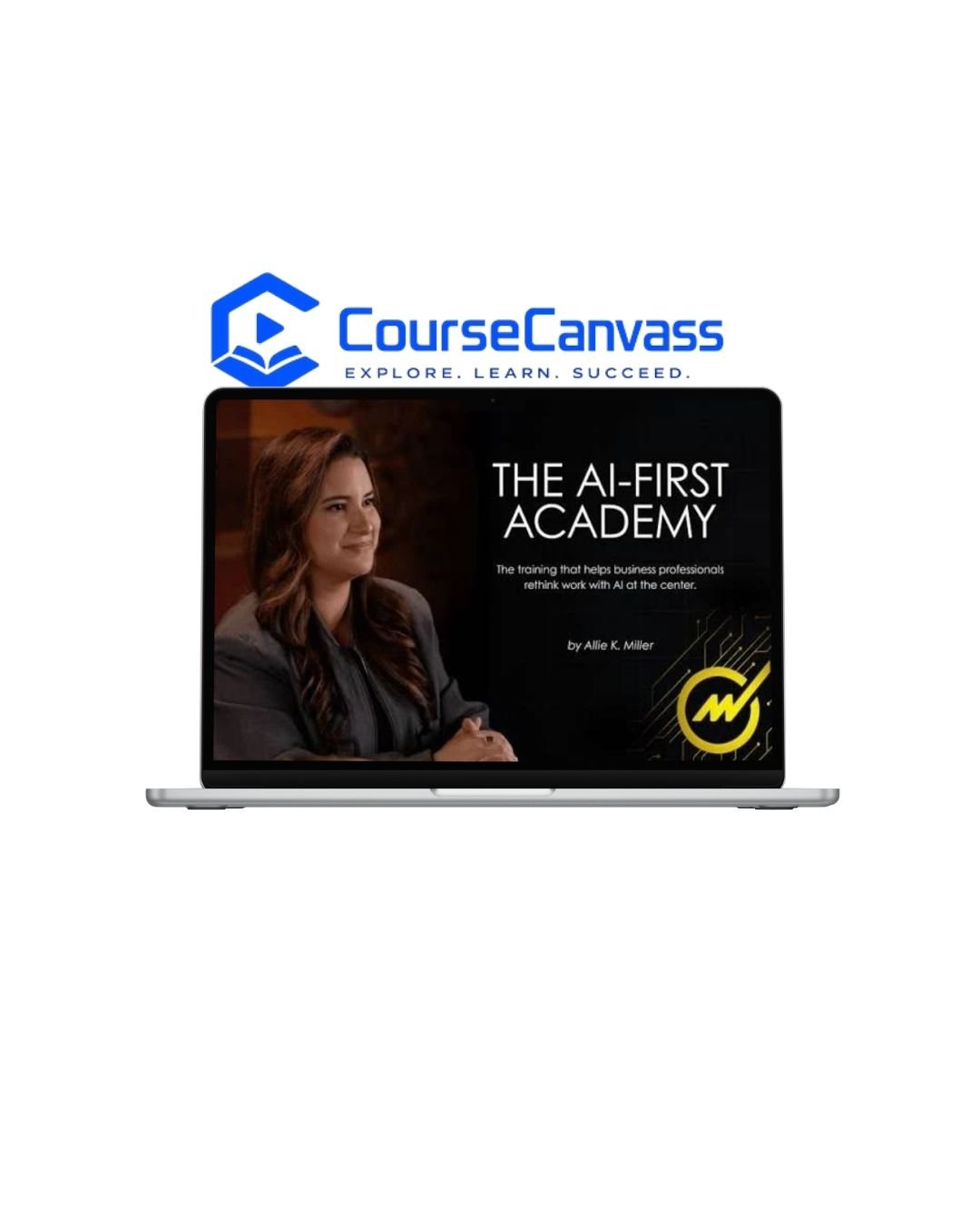
Allie K. Miller – AI First Academy (2026)
Original price was: $397.00.$20.00Current price is: $20.00.
Interested in purchasing this course?Contact us directly to receive your payment link. 🟢 Get Payment Link on WhatsApp
AI First Academy by Allie K. Miller (2026) is a premium AI Strategy course designed for entrepreneurs, executives, business leaders, managers, consultants, marketers, and professionals who want to understand AI strategy, identify practical business applications, implement AI effectively, improve productivity, and build organizations prepared for an AI-driven future.
Description
Proof
AI First Academy by Allie K. Miller is a comprehensive AI Strategy course designed for entrepreneurs, executives, business leaders, managers, consultants, marketers, and professionals who want to understand how artificial intelligence can transform modern organizations. The program focuses on AI strategy, business transformation, AI adoption, productivity, automation, leadership, AI tools, and developing practical frameworks for integrating artificial intelligence into business operations.
Artificial intelligence is rapidly changing how organizations approach productivity, customer experiences, decision-making, marketing, operations, and innovation. Businesses that successfully adopt AI need more than access to individual tools. They require clear strategies for identifying valuable use cases, preparing teams, managing implementation, measuring results, and adapting their operations as AI capabilities evolve.
The program begins with the fundamentals of AI strategy. Students explore how organizations can evaluate artificial intelligence opportunities and connect AI initiatives with broader business objectives. A strategic approach helps businesses prioritize useful applications rather than adopting technology simply because it is available.
A major focus of the curriculum is AI adoption. Participants learn how businesses can introduce AI into existing workflows while considering organizational priorities, employee capabilities, technology requirements, and potential challenges. Successful adoption requires both technological understanding and effective change management.
The course also explores AI-powered productivity. Learners examine how artificial intelligence can support research, writing, analysis, communication, planning, information management, and other professional activities. Using AI appropriately can help teams reduce repetitive work and dedicate more time to higher-value responsibilities.
Business automation is another important component of the program. Students discover how AI can assist with repetitive operational processes and workflows. Identifying suitable automation opportunities can improve efficiency while allowing organizations to develop more scalable business systems.
The curriculum also emphasizes AI tools and use cases. Participants develop a broader understanding of how different AI capabilities can support functions such as marketing, sales, operations, customer service, research, content creation, and business analysis. Matching tools to specific business problems is an important part of effective AI implementation.
AI transformation receives significant attention throughout the training. Learners examine how organizations can rethink existing processes and identify opportunities for AI-assisted innovation. Rather than simply adding AI to existing tasks, businesses can evaluate whether certain workflows can be redesigned to achieve better outcomes.
Leadership and organizational change are integrated throughout the program. Students explore the role leaders play in communicating AI initiatives, encouraging responsible experimentation, supporting employees, and establishing appropriate expectations. Strong leadership can help organizations navigate technological change more effectively.
The program also covers AI governance and responsible implementation. Participants learn why businesses should consider data privacy, information accuracy, human oversight, security, transparency, and appropriate use when integrating AI into professional environments. Responsible practices help organizations build trust while reducing avoidable risks.
Data-driven decision-making is another valuable topic. Learners explore how AI can assist with analyzing information, identifying patterns, summarizing complex material, and supporting business decisions. Human judgment remains essential when evaluating AI-generated insights and making consequential decisions.
The course also addresses the development of an AI-first organizational mindset. Students learn how teams can identify opportunities for continuous improvement and incorporate AI into everyday workflows rather than treating it as an isolated technology project. An AI-first approach can encourage experimentation, learning, and operational innovation.
Performance measurement is incorporated into the broader strategy. Participants can evaluate AI initiatives based on productivity improvements, operational efficiency, customer outcomes, adoption, cost considerations, and other relevant business indicators. Measuring results helps organizations determine which initiatives deserve further investment.
Whether you’re leading a company, developing an AI transformation strategy, managing a team, building an AI-powered business, or simply looking to understand how artificial intelligence can create practical business value, AI First Academy by Allie K. Miller (2026) provides a structured foundation for approaching AI strategically.
By combining AI strategy, AI adoption, business transformation, AI tools, automation, productivity, leadership, responsible AI, organizational change, and performance measurement, AI First Academy equips learners with practical knowledge for developing effective AI strategies and preparing businesses for an increasingly AI-driven economy.
FAQs
What is AI First Academy?
It is an AI Strategy course focused on AI adoption, business transformation, productivity, automation, AI tools, leadership, and building AI-first organizations.
Who should take this course?
The course is ideal for entrepreneurs, executives, business leaders, managers, consultants, marketers, and professionals interested in implementing AI strategically.
Is this course beginner-friendly?
Yes. It introduces AI strategy fundamentals before progressing to AI adoption, automation, business transformation, leadership, governance, and organizational implementation.
What topics are covered?
The course covers AI strategy, AI adoption, business transformation, AI tools, automation, productivity, leadership, responsible AI, organizational change, AI use cases, and performance measurement.
Why is AI strategy important?
A clear AI strategy helps organizations identify valuable use cases, prioritize investments, improve productivity, manage adoption, reduce implementation risks, and connect AI initiatives with broader business objectives.
Related products
-
Sale!

James Goldbach-Agent Architects
Original price was: $77.00.$11.00Current price is: $11.00. -
Sale!

Corey Ganim-AI Operator Academy
Original price was: $999.00.$64.00Current price is: $64.00. -
Sale!
Prajwal Tomar-AI MVP Builders
Original price was: $35.00.$15.00Current price is: $15.00. -
Sale!

AI With Gary-Gary YouTube & AI Automation
Original price was: $67.00.$15.00Current price is: $15.00.

Reviews
There are no reviews yet.