
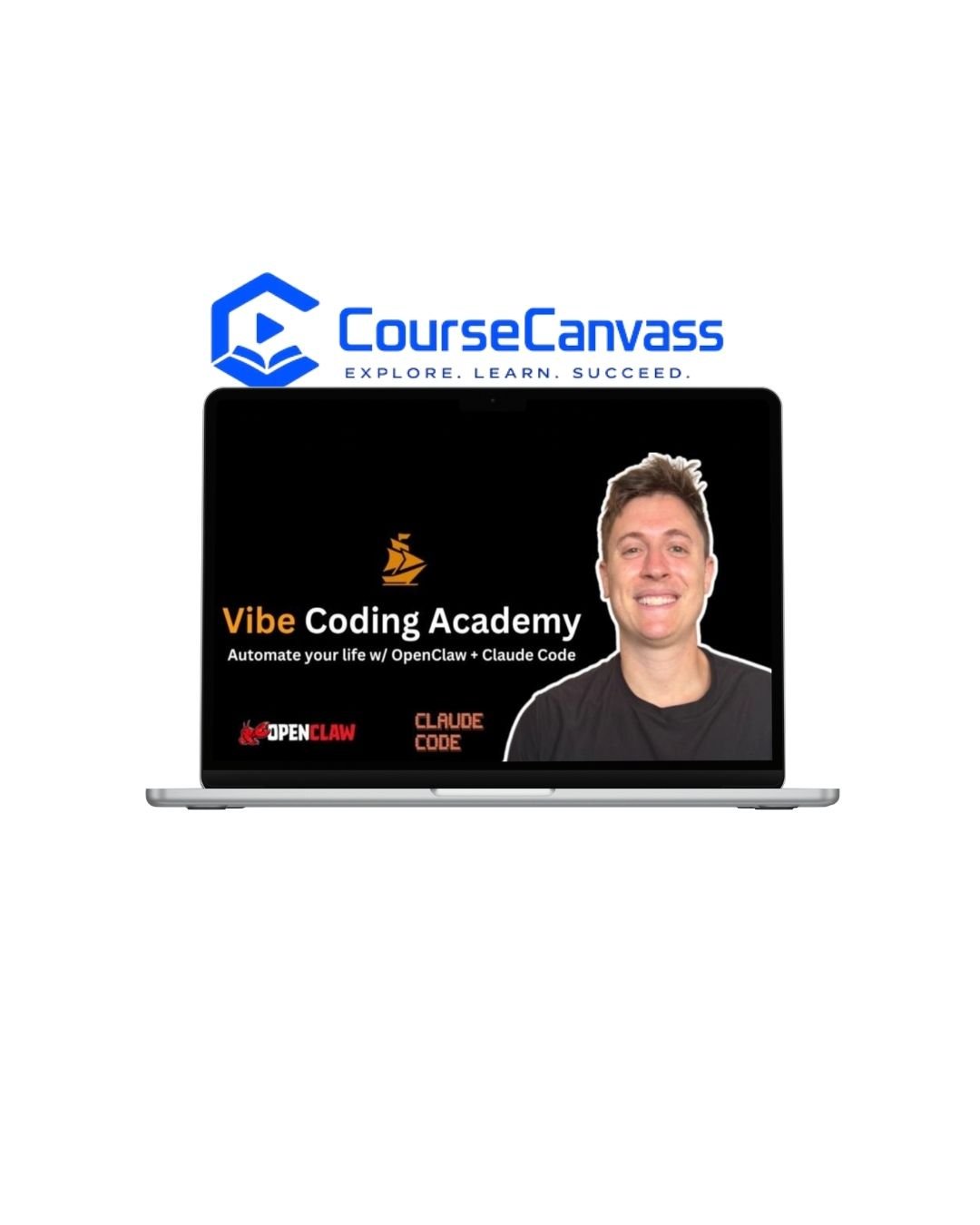
Alex Finn-Vibe Coding Academy
Original price was: $97.00.$20.00Current price is: $20.00.
Interested in purchasing this course?Contact us directly to receive your payment link. 🟢 Get Payment Link on WhatsApp
Vibe Coding Academy by Alex Finn (July 2026) is a premium AI Development course designed for entrepreneurs, developers, founders, freelancers, creators, product managers, and beginners who want to build AI-powered applications using modern coding agents and AI-assisted software development workflows.
Description
Proof
Vibe Coding Academy by Alex Finn is a comprehensive AI Development course created for entrepreneurs, software developers, founders, freelancers, product managers, creators, and aspiring builders who want to create real software products using modern AI-powered coding tools. The program focuses on teaching practical development workflows where artificial intelligence assists throughout the software development lifecycle, enabling learners to transform ideas into working applications more efficiently.
Artificial intelligence has fundamentally changed software development by enabling developers to describe desired outcomes while AI coding assistants help generate, organize, and improve code. Instead of replacing software engineers, AI increases productivity by reducing repetitive work, accelerating prototyping, and supporting faster experimentation. This course demonstrates how developers can combine technical thinking with AI-assisted workflows to build production-ready applications.
The program begins by introducing the fundamentals of AI development. Students learn how AI coding assistants operate, how modern development environments integrate artificial intelligence, and how prompt-driven development differs from traditional programming workflows. Understanding these concepts creates a strong foundation before moving into larger application projects.
A major focus of the curriculum is AI-assisted software development. Participants discover structured methods for planning applications, generating project architecture, creating features, refining functionality, and validating AI-generated implementations. Rather than relying on isolated prompts, the course emphasizes repeatable engineering workflows that improve software quality while increasing development speed.
The course also emphasizes Claude Code and modern coding agents. Learners explore how AI-powered development tools assist with coding, debugging, documentation, feature implementation, and project organization. These AI assistants help reduce repetitive engineering tasks while allowing developers to focus on architecture, product strategy, and user experience.
Prompt engineering receives significant attention throughout the training. Students learn how to communicate effectively with AI coding systems by providing clear objectives, technical context, constraints, and iterative feedback. Strong prompting skills improve the quality of generated code while reducing unnecessary revisions during development.
Application building forms another essential component of the learning experience. Participants develop practical systems for transforming ideas into functional products by combining planning, interface development, backend logic, integrations, testing, and deployment. Structured workflows help learners create projects that remain organized and maintainable as complexity grows.
The curriculum also explores AI product development. Learners understand how AI-assisted software creation supports rapid prototyping, MVP development, product validation, and continuous improvement. Faster iteration enables founders and developers to test ideas efficiently while collecting meaningful user feedback.
Development productivity is integrated throughout the course. Students organize projects, automate repetitive workflows, maintain documentation, collaborate efficiently, and optimize software engineering processes using AI-powered development environments. Organized systems improve consistency while supporting long-term project scalability.
Testing and code quality are another important topic covered during the training. Participants examine methods for reviewing AI-generated code, validating functionality, improving maintainability, and ensuring software reliability before deployment. Human oversight remains central to building production-quality applications.
The course also encourages responsible AI software development by emphasizing code verification, security awareness, maintainability, ethical AI usage, and thoughtful engineering practices. AI serves as a development assistant while developers remain responsible for technical quality and final implementation.
Whether you’re launching a startup, building AI-powered applications, learning modern software engineering, creating SaaS products, or improving your developer productivity, Vibe Coding Academy by Alex Finn (July 2026) provides practical frameworks for building software with AI-assisted development workflows.
By combining AI development, AI coding assistants, Claude Code, prompt engineering, software architecture, AI product development, workflow automation, application testing, engineering productivity, and responsible software engineering practices, Vibe Coding Academy equips learners with practical skills needed to build modern AI-powered software products.
Related products
-
Sale!

Alex Finn – Vibe Coding Academy (2026)
Original price was: $97.00.$22.00Current price is: $22.00. -
Sale!
Sumin Yasir-Claud Club (2026) | AI & Automation Course
Original price was: $2,999.00.$43.00Current price is: $43.00. -
Sale!

James Goldbach-Agent Architects
Original price was: $77.00.$11.00Current price is: $11.00. -
Sale!

Pat Walls – AI App Bootcamp 2026
Original price was: $395.00.$20.00Current price is: $20.00.

Reviews
There are no reviews yet.